
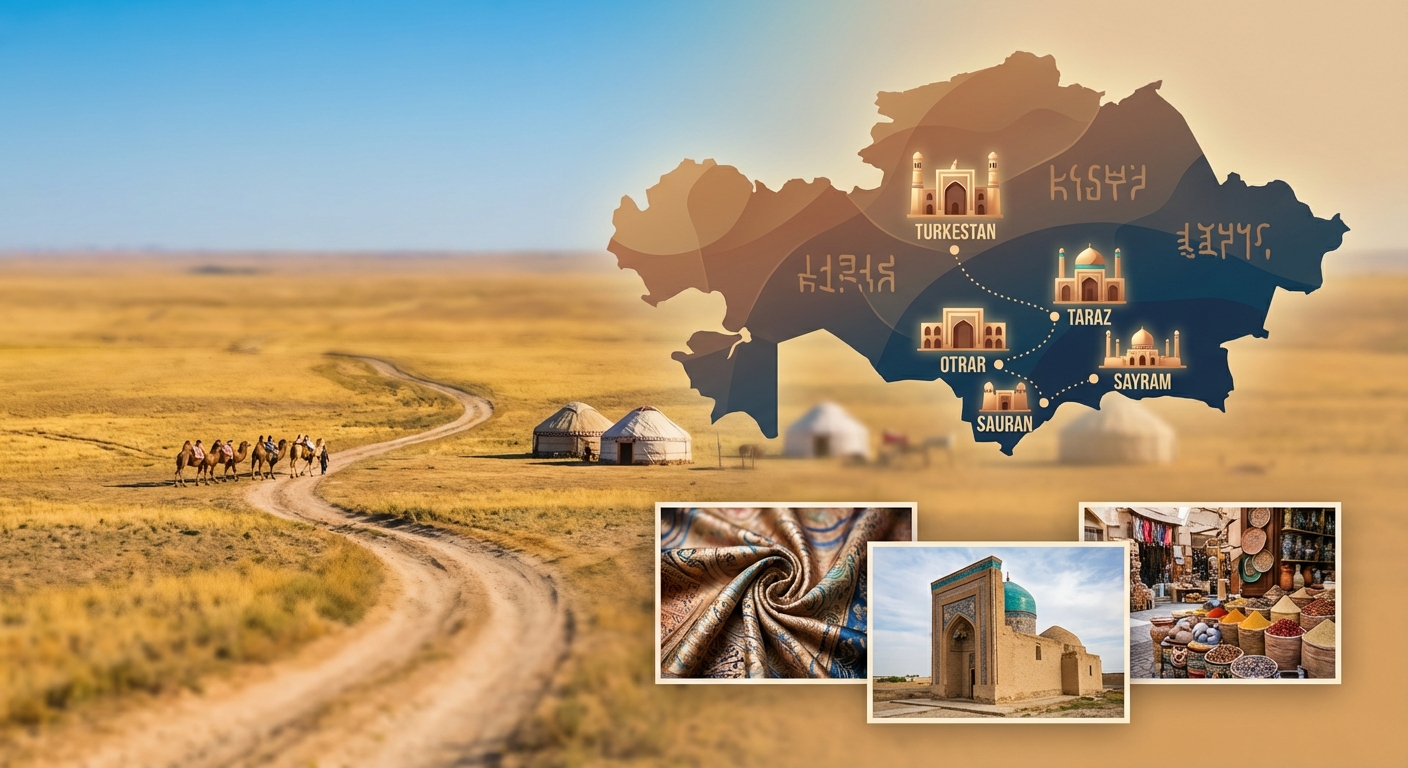
Most travelers know Uzbekistan’s Samarkand or Turkmenistan’s Merv when they think of the Silk Road. But Kazakhstan holds some of the most fascinating and least visited ancient cities along these legendary trade routes. These settlements once thrived as crucial stopover points where caravans rested, merchants traded, and cultures collided.
Kazakhstan’s silk road cities offer remarkably preserved archaeological sites without the crowds found elsewhere in Central Asia. From Otrar’s ancient ruins to Taraz’s standing medieval monuments, these five cities reveal centuries of trade, conquest, and cultural exchange. Most sites require minimal permits, offer affordable accommodations, and connect easily with modern Kazakhstan’s infrastructure, making them accessible for independent travelers seeking authentic historical experiences.
Otrar: The Ruined City That Changed History
Otrar sits in southern Kazakhstan, roughly 150 kilometers northwest of Shymkent. This archaeological site sprawls across the desert, its mud brick walls still visible against the horizon.
The city reached its peak between the 9th and 12th centuries. Merchants stopped here to trade silk, spices, and precious metals. The settlement controlled vital water sources in an otherwise harsh landscape.
Then came 1219. A Mongol caravan arrived in Otrar, and the local governor executed the traders and seized their goods. Genghis Khan demanded justice. When Otrar’s ruler refused, the Mongol army besieged the city for five months. The destruction was absolute.
Today, you can walk through the excavated remains. The citadel walls still stand several meters high in places. Archaeologists have uncovered bathhouses, mosques, and residential quarters. The site museum displays coins, pottery, and tools found during digs.
Getting There and What to Bring
The nearest major city is Shymkent, which has regular buses and shared taxis to the modern town of Otrar. From there, hire a local driver for the final 15 kilometers to the archaeological site.
Bring plenty of water. The desert sun is intense from May through September. Wear sturdy shoes because the terrain is uneven. A hat and sunscreen are essential.
The site charges a small entrance fee, usually around 500 tenge. Guides are available for hire, though not required. They speak Kazakh and Russian primarily, with some English speakers during peak season.
Taraz: Where Medieval Monuments Still Stand
Taraz is one of the oldest continuously inhabited cities in Kazakhstan. Founded over 2,000 years ago, it served as a major stop on the Silk Road’s northern route.
Unlike Otrar, Taraz never died. Modern buildings now surround the historical monuments, but several structures from the medieval period remain intact.
The Aisha Bibi Mausoleum is the crown jewel. Built in the 11th or 12th century, this terracotta masterpiece features intricate geometric patterns on every surface. No two decorative tiles are identical. The craftsmanship rivals anything found in Samarkand or Bukhara.
Nearby stands the Karakhan Mausoleum, another medieval tomb with a distinctive conical dome. Both structures underwent careful restoration in the 20th century, but much of the original material remains.
The city also has a small archaeological museum with artifacts spanning two millennia. Exhibits include Sogdian coins, Buddhist relics, and Islamic manuscripts.
Planning Your Visit
Taraz has a proper city infrastructure. Hotels range from budget guesthouses to mid-range business hotels. Restaurants serve traditional Kazakh food alongside Russian and international options.
The mausoleums are within walking distance of each other, about 30 minutes from the city center by taxi. Both sites welcome visitors daily except Mondays. Photography is permitted.
Consider timing your visit for spring (April to May) or autumn (September to October). Summer temperatures regularly exceed 35°C, while winter can drop below freezing.
Sauran: The Forgotten Fortress City
Sauran lies approximately 40 kilometers north of Turkestan. This medieval city was one of the largest settlements in southern Kazakhstan during the 14th and 15th centuries.
The site impresses with its sheer scale. Massive defensive walls encircle an area of roughly 40 hectares. Some sections of the walls still reach 15 meters in height. Four main gates once controlled access to the city.
Inside the walls, archaeologists have identified residential areas, workshops, and public buildings. The city had a sophisticated water supply system, with underground channels bringing water from distant sources.
Sauran thrived under Timurid rule but declined after the 16th century as trade routes shifted. By the 18th century, the city was abandoned.
What Makes Sauran Special
Unlike more famous Silk Road sites, Sauran receives few visitors. You might have the entire archaeological zone to yourself, especially on weekdays.
The lack of restoration means you see the ruins in their natural state. Erosion has sculpted the mud brick walls into organic shapes. The site feels haunting and authentic.
Bring a camera with a wide-angle lens. The scale of the walls and the desert backdrop create dramatic compositions.
Access is straightforward from Turkestan, which has hotels and restaurants. Hire a taxi for a half-day trip to Sauran. The road is paved most of the way, though the final stretch can be rough after rain.
Turkestan: The Living Spiritual Center
Turkestan deserves special attention among silk road cities Kazakhstan preserves. The city centers on the Mausoleum of Khoja Ahmed Yasawi, a UNESCO World Heritage site and one of Central Asia’s most important Islamic monuments.
Timur ordered the mausoleum’s construction in the late 14th century. The building was never fully completed, but what stands today is breathtaking. The turquoise dome rises 39 meters high. The interior features massive bronze cauldrons, intricate tilework, and calligraphy.
The complex includes multiple prayer halls, a library, and residential quarters. Pilgrims have visited for centuries, making Turkestan second only to Mecca for many Central Asian Muslims.
Beyond the mausoleum, the city has several other historical sites. The underground mosque of Khilvet dates to the 12th century. The medieval bathhouse complex shows how public facilities operated during the Silk Road era.
Practical Information for Travelers
Turkestan is the most tourist-ready destination on this list. The city has invested heavily in infrastructure over the past decade.
New hotels opened near the mausoleum complex. Restaurants serve both traditional and modern cuisine. English signage appears at major sites.
The train station connects Turkestan to Almaty, Shymkent, and the capital. High-speed trains make the journey comfortable and affordable.
Plan to spend at least a full day here. The mausoleum complex alone warrants several hours. Evening visits are particularly beautiful when the buildings are illuminated.
Dress modestly when visiting religious sites. Women should cover their shoulders and knees. Headscarves are not required for non-Muslim visitors but are respectful.
Sayram: The Ancient Oasis Settlement
Sayram sits just east of Shymkent, making it an easy day trip. This settlement dates back over 3,000 years, making it one of the oldest continuously inhabited places in Kazakhstan.
The town served as an important oasis on the Silk Road’s southern route. Fresh water from nearby mountains supported agriculture and provided relief for weary travelers.
Several medieval monuments survive in Sayram. The Khizr Mosque features traditional Central Asian architecture with a blue-tiled dome. The Abdel Aziz Bab Mausoleum honors a local religious leader from the 10th century.
The town has a distinctly different feel from the archaeological sites. People still live in traditional houses along narrow streets. Markets sell fresh produce and local crafts. The pace is slower than in modern cities.
How to Experience Sayram
Public buses run regularly from Shymkent to Sayram. The journey takes about 30 minutes. Shared taxis are faster and only slightly more expensive.
Walk through the old town to appreciate the traditional architecture. Many houses feature carved wooden doors and decorative brickwork.
Local guides offer tours in Russian and Kazakh. Some speak basic English. They can arrange visits to private courtyards and explain the historical significance of various buildings.
The best time to visit is during spring when fruit trees bloom throughout the oasis. The contrast between the green gardens and the surrounding desert is striking.
Planning Your Silk Road Journey Through Kazakhstan
Visiting these five cities requires some planning but presents no major obstacles for independent travelers.
Step-by-Step Itinerary Planning
- Start in Almaty, Kazakhstan’s largest city with the best international connections.
- Take a domestic flight or train to Shymkent, your base for southern Kazakhstan.
- Visit Sayram first as a half-day trip from Shymkent.
- Spend a full day at Otrar, hiring a driver from Shymkent.
- Travel to Turkestan and spend one or two nights there.
- Make a half-day trip to Sauran from Turkestan.
- Continue to Taraz by train or shared taxi for your final stop.
- Return to Almaty or continue west toward other destinations.
This route minimizes backtracking and follows a logical geographic progression.
Best Times to Visit
Spring (April through May) and autumn (September through October) offer the most comfortable weather. Temperatures range from 15°C to 25°C. Rain is infrequent but possible.
Summer (June through August) brings intense heat, often exceeding 40°C in southern Kazakhstan. Early morning visits are essential. Carry extra water.
Winter (November through March) is cold, with temperatures often below freezing. Some archaeological sites become difficult to access due to snow or ice. Indoor museums remain open.
Essential Preparation
Kazakhstan requires visas for many nationalities, though recent changes have expanded visa-free access. Check current requirements well before your trip using resources like the Kazakhstan visa guide.
Learn basic Russian phrases. English is not widely spoken outside major hotels in Almaty and the capital. Translation apps help but are not always reliable in areas with poor internet coverage.
Cash remains important in smaller cities. ATMs are available in Shymkent, Turkestan, and Taraz, but bring enough tenge for several days when visiting remote sites.
Comparing Kazakhstan’s Silk Road Sites to Other Central Asian Destinations
| Aspect | Kazakhstan Sites | Uzbekistan Sites | Kyrgyzstan Sites |
|---|---|---|---|
| Crowd levels | Very low to moderate | High in Samarkand/Bukhara | Low to moderate |
| Preservation state | Mix of ruins and restored | Heavily restored | Mostly natural ruins |
| Tourist infrastructure | Developing rapidly | Well established | Basic facilities |
| English accessibility | Limited | Moderate | Limited |
| Authenticity | High | Moderate (heavy restoration) | Very high |
| Ease of access | Good roads, regular transport | Excellent | Can be challenging |
The table shows Kazakhstan offers a middle ground. Sites are accessible but not overrun. Restoration respects original materials rather than creating Disneyland versions of history.
“Kazakhstan’s Silk Road cities give you the feeling of discovery that Uzbekistan lost decades ago. You’re not fighting crowds for photos. You’re not walking through heavily commercialized bazaars. You’re seeing history in a more raw, authentic state.” – Sarah Mitchell, cultural heritage specialist
What to Pack for Archaeological Site Visits
The right gear makes a significant difference when visiting ancient ruins in Kazakhstan’s climate.
Essential items include:
- Sturdy hiking boots or trail shoes with good ankle support
- Wide-brimmed hat for sun protection
- High SPF sunscreen and lip balm
- Reusable water bottle (2 liter capacity minimum)
- Light, breathable long-sleeved shirt to prevent sunburn
- Portable phone charger since sites lack electricity
- Small first aid kit with blister treatment
- Snacks like nuts or energy bars
- Notebook and pen for recording observations
- Binoculars for viewing architectural details
Photography equipment deserves special consideration. Dust is pervasive at archaeological sites. Bring a lens cleaning kit and protective bags for cameras. A polarizing filter helps manage the intense desert light.
Common Mistakes to Avoid
| Mistake | Why It’s a Problem | Better Approach |
|---|---|---|
| Visiting only Turkestan | You miss the diversity of sites | Plan for at least three cities |
| Traveling in July or August | Extreme heat makes ruins uncomfortable | Choose spring or autumn instead |
| Relying only on English | Very few people speak it outside hotels | Learn basic Russian phrases |
| Skipping local guides | You miss historical context and stories | Hire guides at major sites |
| Wearing sandals to ruins | Uneven ground causes injuries | Bring proper hiking footwear |
| Not carrying cash | Cards don’t work at many sites | Withdraw tenge in cities |
Combining Ancient Sites with Modern Kazakhstan
Kazakhstan offers a unique opportunity to contrast ancient Silk Road cities with contemporary development. The capital city showcases futuristic architecture that seems worlds away from medieval ruins.
After visiting southern historical sites, consider spending time in the modern capital. The contrast is jarring but illuminating. You see how Kazakhstan bridges its ancient heritage with ambitious 21st-century aspirations.
If you have limited time, even a 24-hour visit provides perspective on the country’s dual identity.
Food and Accommodation Along the Route
Southern Kazakhstan offers hearty traditional cuisine. Expect lots of meat, bread, and dairy products.
Plov (rice pilaf with lamb) appears on every menu. Lagman (hand-pulled noodles) provides a filling meal. Samsa (baked pastries with meat filling) make excellent snacks during site visits.
Vegetarians face challenges but can find options. Request vegetable plov or ask for dishes without meat. Bread, cheese, and fresh produce are always available at local markets.
Accommodation ranges from basic guesthouses to comfortable mid-range hotels. Shymkent and Turkestan have the best selection. Taraz offers decent options. Near Otrar and Sauran, choices are limited to simple homestays or returning to larger cities.
Book accommodations in advance during peak season (April to May and September to October). Summer and winter see fewer visitors, making last-minute bookings easier.
Photography Tips for Ancient Sites
Kazakhstan’s silk road cities offer incredible photographic opportunities. The light, landscape, and architecture combine beautifully.
Golden hour (the hour after sunrise and before sunset) provides the best light. The low angle emphasizes texture in mud brick walls. Shadows add depth and drama.
Include scale in your compositions. Ancient walls look more impressive when viewers can judge their size. Include a person, vehicle, or modern building for reference.
Wide-angle lenses capture the scope of sites like Sauran. Telephoto lenses let you isolate architectural details at Taraz’s mausoleums. Bring both if possible.
Respect any photography restrictions at religious sites. Always ask permission before photographing people. Offer to share photos via email or messaging apps.
If you’re serious about architectural photography, techniques from resources about photographing modern buildings often apply to historical structures too.
Cultural Etiquette and Respectful Travel
Kazakhstan welcomes visitors but appreciates cultural sensitivity. Understanding local customs enhances your experience and shows respect.
Greet people with a handshake. Remove shoes when entering homes. Accept offered tea, even if you only take a few sips. Refusing hospitality can offend.
Dress conservatively, especially at religious sites and in smaller towns. Men should avoid shorts in mosques. Women should cover shoulders and knees.
Photography requires permission in some contexts. Always ask before photographing people, especially women. Some older individuals believe cameras capture their soul.
Learn a few Kazakh or Russian phrases. “Rakhmet” (thank you in Kazakh) and “spasibo” (thank you in Russian) go a long way. Locals appreciate any effort to speak their language.
Bargaining is acceptable at markets but not in shops with fixed prices. Be friendly and good-humored during negotiations. Walking away often brings sellers down to reasonable prices.
Connecting with Local Historians and Guides
Local experts transform visits from simple sightseeing to genuine learning experiences. They share stories, legends, and historical context that no guidebook captures.
Universities in Shymkent and Taraz employ archaeologists and historians who sometimes offer private tours. Contact history departments several weeks before your trip to arrange meetings.
Regional museums often have staff who moonlight as guides. Ask at museum reception desks. These guides typically charge reasonable rates and provide deep knowledge.
Online forums and travel groups connect you with local experts. Facebook groups focused on Kazakhstan travel often have members who offer guiding services or connect you with qualified individuals.
Be prepared to communicate in Russian. Professional translators can join tours if arranged in advance, though this adds cost.
Why Kazakhstan’s Silk Road Deserves Your Time
These five cities represent just a fraction of Kazakhstan’s Silk Road heritage, but they offer an excellent introduction. You’ll walk through sites where merchants rested, armies clashed, and cultures merged.
The relative lack of tourism means authentic experiences. You’re not following tour groups or competing for photos. You’re discovering history at your own pace, often in solitude.
Kazakhstan’s silk road cities prove that the most rewarding travel experiences often lie beyond the well-trodden paths. These ancient settlements wait for travelers willing to venture slightly off the main Central Asian tourist circuit. The rewards are substantial for those who make the journey.