
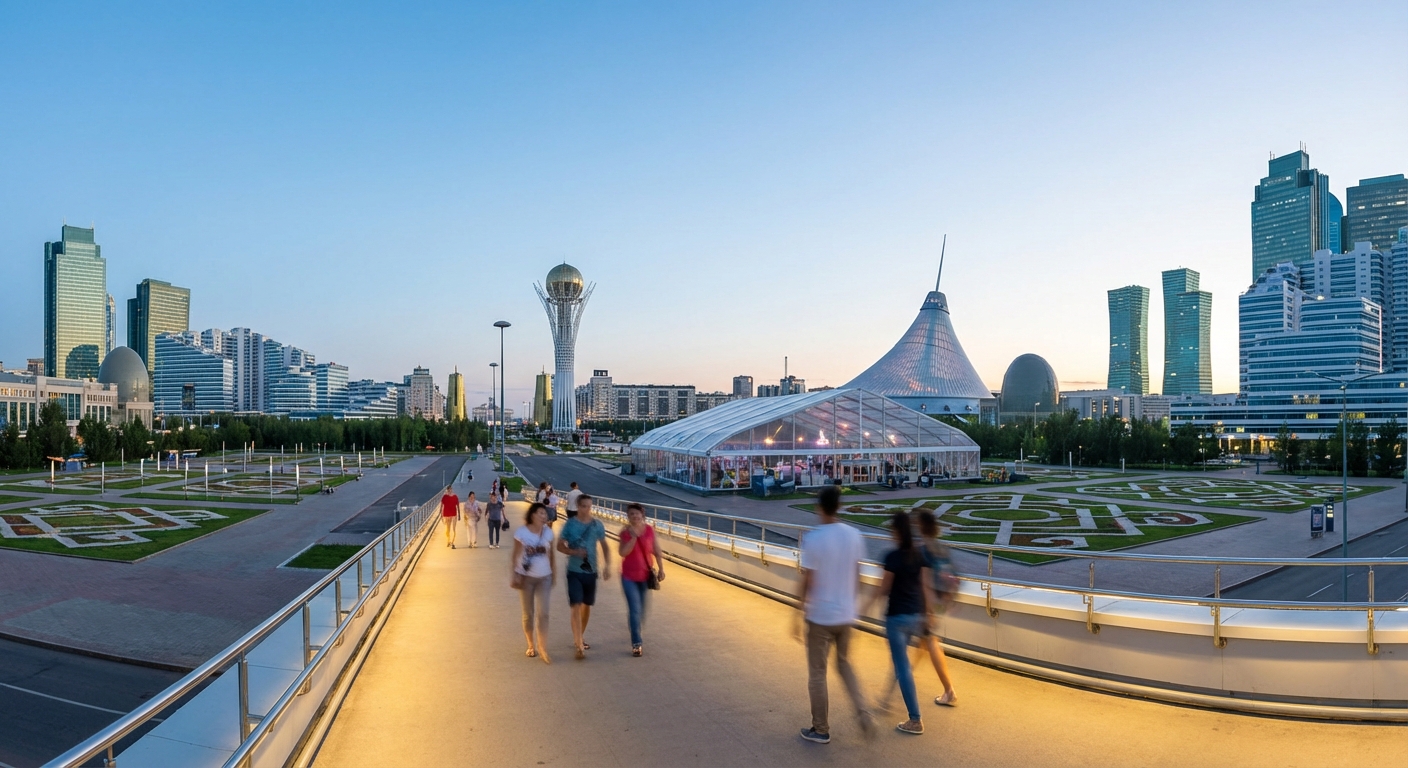
Walking through Astana’s Left Bank feels like stepping onto a movie set designed by architects who decided gravity was optional. Golden domes catch the sunlight beside glass pyramids. Skyscrapers twist into impossible shapes. And somehow, all of it sits comfortably on the windswept steppes of Central Asia, defying every expectation you brought with you.
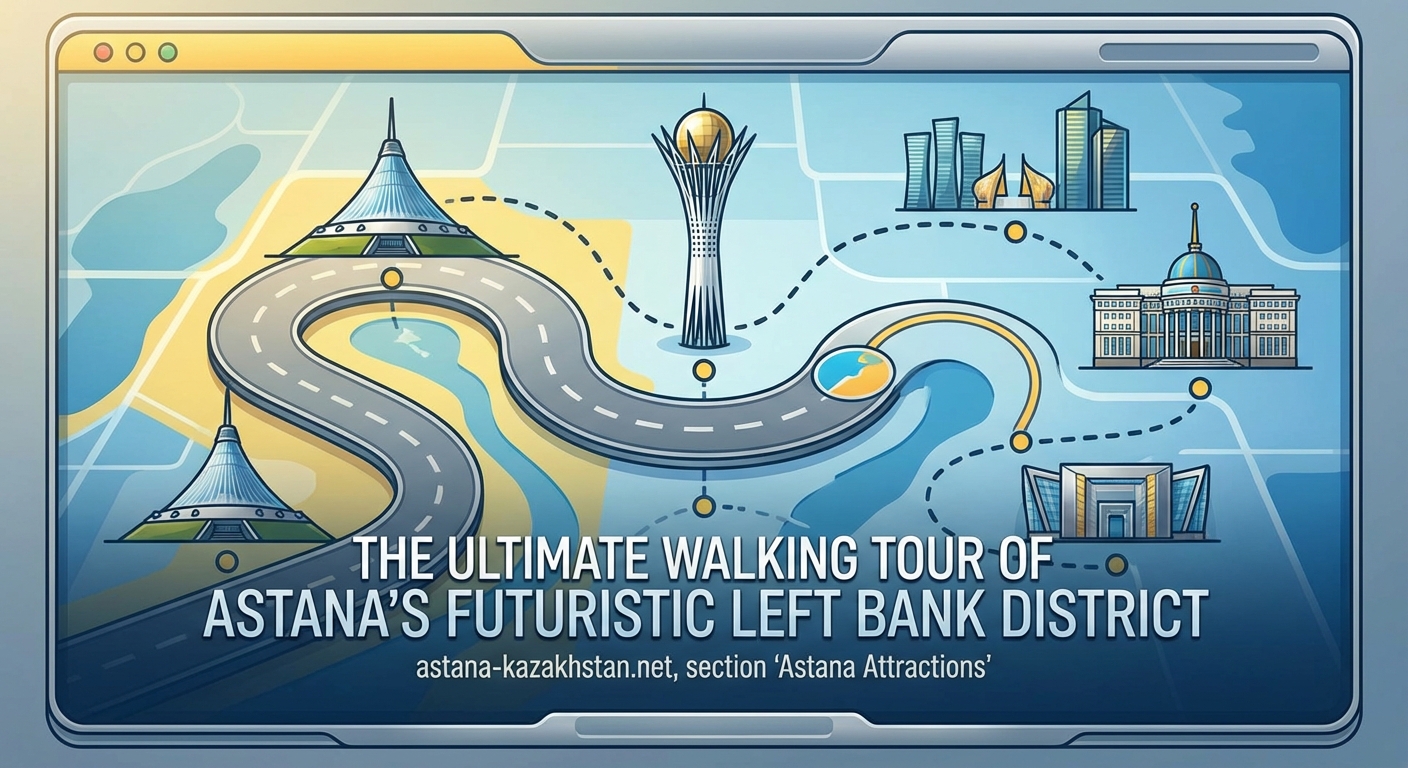
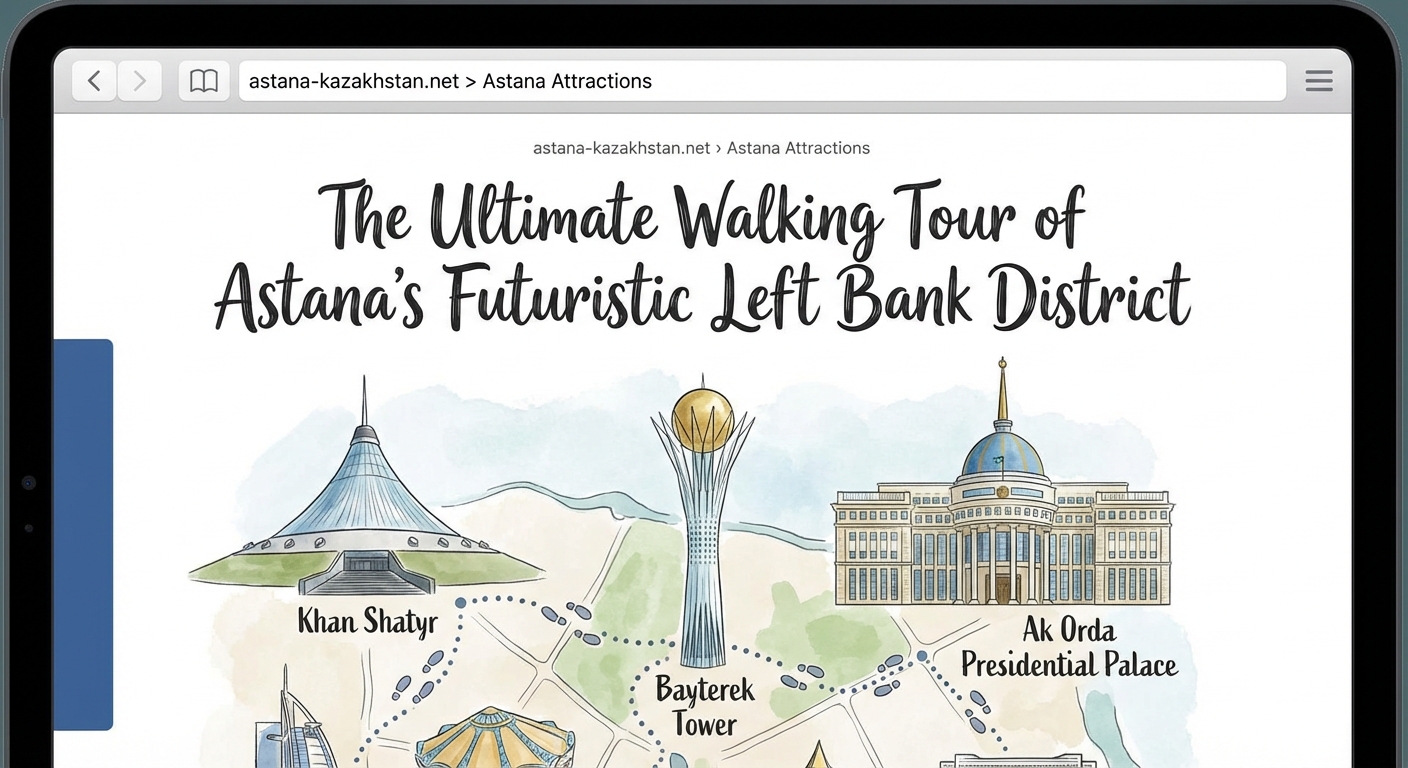
This Astana walking tour covers the Left Bank district’s most striking modern landmarks, including Bayterek Tower, Khan Shatyr, and the Palace of Peace. The route takes 4 to 6 hours at a comfortable pace, covering roughly 8 kilometers. Wear sturdy shoes, bring water, and plan for weather extremes. Most attractions offer free exterior viewing, with optional paid entries to specific buildings.
Why the Left Bank deserves your attention
The Ishim River divides Astana into two distinct personalities. The Right Bank holds Soviet-era buildings and older neighborhoods. The Left Bank represents Kazakhstan’s ambitions made concrete, steel, and glass.
This is where President Nursultan Nazarbayev decided to build a capital worthy of a resource-rich nation stepping onto the world stage. Construction began in the late 1990s. Today, the district showcases work by Norman Foster, Manfredi Nicoletti, and other internationally recognized architects.
The result? A cityscape that photographs like Dubai but costs a fraction to visit.
Most visitors spend one or two days here. That’s enough to see the major landmarks and understand why Astana attracts architecture enthusiasts from across the globe.
Planning your Astana walking tour
Start early. Summer temperatures can hit 35°C by midday. Winter drops to -30°C or colder. Spring and autumn offer the most comfortable walking conditions, with temperatures between 10°C and 20°C.
Bring these essentials:
- Comfortable walking shoes with good support
- Sunscreen and a hat (summer) or thermal layers (winter)
- Water bottle (refill at malls along the route)
- Charged phone for photos and maps
- Small amount of cash for entry fees
The route works best from 9:00 AM to 3:00 PM. This timing gives you natural light for photography and ensures indoor attractions stay open if you want to enter.
Public restrooms appear regularly inside shopping centers and major landmarks. Most charge 100 to 200 tenge (about $0.20 to $0.40).
Starting point at Bayterek Tower
Begin at Bayterek Tower, the city’s most recognizable symbol. This 97-meter monument represents a Kazakh folk tale about a mythical bird laying a golden egg in a poplar tree.
The number 97 references 1997, the year Astana became Kazakhstan’s capital.
You can ride an elevator to the observation deck for 1,000 tenge. The view gives you a complete panorama of the Left Bank and helps orient yourself for the walk ahead.
Inside the golden sphere at the top, you’ll find a gilded handprint of Nursultan Nazarbayev. Visitors place their hand in the impression and make a wish. It’s touristy, but the view alone justifies the ticket price.
Exit the tower and head west along Nurzhol Boulevard. This pedestrian-friendly avenue forms the spine of your walking tour.
Walking Nurzhol Boulevard
Nurzhol Boulevard stretches 2 kilometers through the heart of the Left Bank. Wide sidewalks, benches, and landscaped gardens make this one of the most pleasant urban walks in Central Asia.
You’ll pass several notable buildings:
The House of Ministries sits on your right, a massive government complex with symmetrical wings. Its scale alone impresses.
Kazakhstan Central Concert Hall appears on your left, designed to resemble a flower petal. The building hosts classical performances and national celebrations.
Keep walking until you reach the Presidential Palace, officially called Ak Orda. This white and blue building with a golden dome serves as the workplace of Kazakhstan’s president. You can’t enter, but the exterior photographs beautifully, especially when fountains in front operate during warmer months.
“Astana’s architecture tells you everything about Kazakhstan’s self-image. This isn’t a country looking backward. Every building here points toward what they want to become.” — Travel writer Sarah Chen, visiting Astana for the third time.
Khan Shatyr Entertainment Center
From the Presidential Palace, walk north toward the enormous tent-like structure visible from almost anywhere in the district. This is Khan Shatyr, designed by Norman Foster and opened in 2010.
The transparent ETFE fabric roof covers an area larger than 10 football fields. Inside, you’ll find:
- A shopping mall with international and local brands
- Restaurants serving Kazakh, Russian, and international cuisine
- An indoor beach resort (yes, with sand and palm trees)
- Entertainment facilities including mini golf
The climate control system maintains comfortable temperatures year-round, even when outside conditions reach extremes. In winter, locals treat this as a warm escape. In summer, it offers air-conditioned relief.
Entry is free. You can walk through, grab lunch, or simply appreciate the engineering that keeps a tropical environment functioning in a city where winter temperatures regularly drop below -20°C.
Palace of Peace and Reconciliation
Exit Khan Shatyr and walk southeast toward the pyramid rising from the landscape. This is the Palace of Peace and Reconciliation, another Norman Foster design completed in 2006.
The 62-meter pyramid hosts the Congress of Leaders of World and Traditional Religions, a triennial gathering promoting interfaith dialogue. The building’s symbolism runs deep: the pyramid represents humanity coming together, with an apex pointing toward shared understanding.
Tours cost around 1,500 tenge and take you through the opera hall, exhibition spaces, and up to the apex, where stained glass by artist Brian Clarke creates kaleidoscopic light patterns.
Even if you skip the interior tour, walking around the exterior gives you a sense of the structure’s ambition. The proportions and clean lines photograph exceptionally well during golden hour.
Hazrat Sultan Mosque
Continue southeast to reach Central Asia’s largest mosque. Hazrat Sultan Mosque opened in 2012 and accommodates up to 10,000 worshippers.
The white marble exterior features traditional Islamic geometric patterns alongside modern construction techniques. Four 77-meter minarets anchor the corners. The central dome rises 51 meters and spans 28 meters in diameter.
Non-Muslim visitors are welcome outside prayer times. Dress modestly: covered shoulders and knees for everyone, headscarves available for women at the entrance.
Inside, you’ll find intricate calligraphy, massive chandeliers, and a peaceful atmosphere that contrasts sharply with the futuristic buildings surrounding it. This juxtaposition captures something essential about Kazakhstan: a nation honoring tradition while building aggressively modern infrastructure.
Entry is free. Photography is permitted in most areas, but ask staff if you’re unsure.
National Museum of Kazakhstan
Walk west from the mosque toward the enormous white building with a blue dome. The National Museum of Kazakhstan opened in 2014 and houses the country’s most comprehensive collection of historical and cultural artifacts.
Seven exhibition blocks cover:
- Ancient and medieval history
- Independent Kazakhstan
- Gold and precious metals
- Astana’s development
- Kazakh culture and traditions
- Nature and wildlife
- Temporary exhibitions
Entry costs 1,000 tenge for adults. English labels appear throughout, though some sections have more translation than others.
Budget at least two hours if you want to see the major collections properly. The gold room alone deserves 30 minutes. The exhibits on nomadic culture provide context you won’t find in other museums.
Comparing landmarks and common mistakes
| Landmark | Entry Fee | Time Needed | Common Mistake |
|---|---|---|---|
| Bayterek Tower | 1,000 tenge | 45 minutes | Visiting at midday when crowds peak |
| Khan Shatyr | Free | 30-90 minutes | Expecting traditional shopping experiences |
| Palace of Peace | 1,500 tenge | 60 minutes | Arriving without checking tour times |
| Hazrat Sultan Mosque | Free | 30 minutes | Wearing inappropriate clothing |
| National Museum | 1,000 tenge | 120+ minutes | Underestimating the size of collections |
The biggest mistake visitors make? Trying to rush. This district rewards slow observation. Sit on benches along Nurzhol Boulevard. Watch how locals use these spaces. Notice architectural details that don’t appear in wide-angle photos.
Food and refreshment stops
You’ll find dining options at regular intervals:
Khan Shatyr offers the most variety, from food court options to sit-down restaurants. Prices range from budget-friendly to moderate.
Line Brew near Bayterek serves excellent coffee and pastries. It’s a local chain worth supporting.
Gakku, a restaurant inside the National Museum, serves traditional Kazakh dishes in a modern setting. Try beshbarmak (boiled meat with pasta) or kuyrdak (fried organ meat with potatoes).
For something lighter, vendors sell simit (sesame bread rings) and samsa (baked pastries with meat or potato filling) from carts along Nurzhol Boulevard.
Carry water regardless. The dry climate and long distances between shade make dehydration a real risk, especially in summer.
Photography tips for the route
Golden hour (the hour after sunrise and before sunset) transforms these buildings. The golden dome of Ak Orda literally glows. Bayterek’s glass sphere catches fire with reflected light.
For Bayterek Tower, shoot from the south side of the monument looking north. This angle captures the tower against the Presidential Palace.
Khan Shatyr photographs best from a distance. Walk 200 meters away and shoot with the city skyline in the background.
The Palace of Peace needs a wide-angle lens to capture the full pyramid. Alternatively, shoot details of the apex or entrance.
For the mosque, arrive around 4:00 PM when afternoon light hits the white marble at an angle that brings out texture.
Drone photography requires permits. Don’t risk it without proper authorization, especially near government buildings.
Extending your walking tour
If you have energy remaining, two additions work well:
Nurly Zhol Street runs perpendicular to Nurzhol Boulevard and features the Abu Dhabi Plaza towers, currently among Central Asia’s tallest buildings. The walk adds 30 minutes each way.
The Lovers’ Park sits along the Ishim River and offers green space, walking paths, and a different perspective on the district. It’s particularly pleasant during summer evenings when locals gather.
Both extensions add another 2 to 3 kilometers to your total distance.
Weather considerations by season
Summer (June to August) brings long daylight hours and warm temperatures. Start your walk by 8:00 AM to avoid peak heat. Thunderstorms can develop quickly in the afternoon.
Autumn (September to October) offers the most stable weather. Temperatures stay comfortable, and fall colors add warmth to photographs.
Winter (November to March) challenges even experienced cold-weather travelers. If you visit during this season, dress in layers, limit outdoor time to 30-minute intervals, and use indoor attractions (Khan Shatyr, museums) as warming breaks.
Spring (April to May) can be unpredictable. Bring a light rain jacket and prepare for temperature swings between morning and afternoon.
Accessibility notes
The Left Bank was designed with modern urban planning principles. Wide sidewalks, curb cuts, and relatively flat terrain make this route more accessible than many historic city centers.
Bayterek Tower, Khan Shatyr, and the National Museum all have elevator access and accessible restrooms.
The Palace of Peace tour includes stairs to reach the apex. Ask about alternative viewing areas if stairs present challenges.
Public transportation (buses and taxis) can shorten distances between landmarks if needed. The Yandex.Taxi app works reliably throughout Astana.
Making the most of your time
This walking tour represents the essential Left Bank experience. You’ll see the buildings that define Astana’s international image and understand the ambition driving Kazakhstan’s development.
But don’t just tick off landmarks. Sit in the parks. Watch wedding parties take photos at Bayterek (a local tradition). Notice how the city balances Kazakh identity with international architectural trends.
Talk to locals if you can. Many young people speak English and feel genuinely proud showing visitors around their unusual capital.
Your walk through tomorrow’s city
Astana’s Left Bank won’t remind you of anywhere else you’ve traveled. That’s precisely the point. Kazakhstan built this district to announce its presence as a modern, forward-looking nation.
Whether the architecture moves you or leaves you cold, the ambition behind it deserves recognition. Not many countries build an entirely new capital district in less than 30 years.
Lace up comfortable shoes. Charge your camera. And give yourself permission to be surprised by a city that most travelers still overlook. The buildings alone justify the journey, but the energy of a place still defining itself makes the walking tour genuinely memorable.