
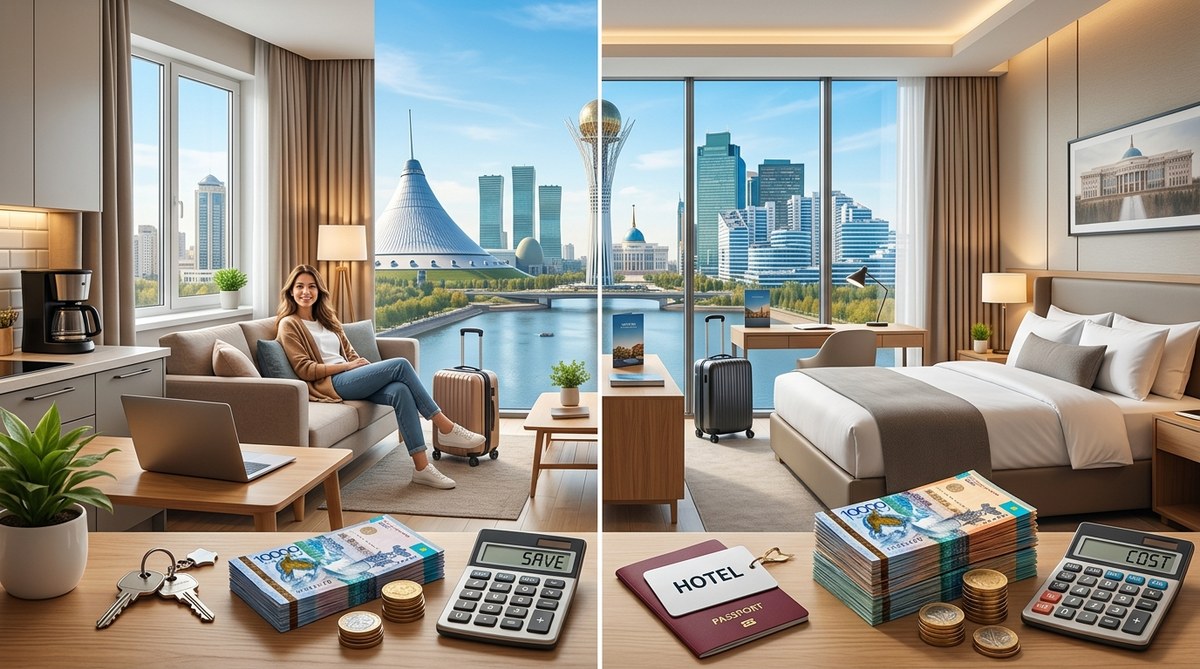
Planning a trip to Astana in 2026 and trying to figure out whether to book a hotel or rent an apartment? You are not alone. Every traveler who lands in this futuristic capital faces the same question, especially when the stay stretches beyond a few days. Hotels offer convenience, daily housekeeping, and a front desk that speaks English. Apartments give you space, a kitchen, and a much lower nightly rate. But the real answer depends on how long you plan to stay, what you value in your downtime, and how much you are willing to trade comfort for savings.
For stays longer than 10 days, renting an apartment in Astana saves you between 40% and 60% compared to a mid-range hotel. A one-month apartment rental in 2026 costs around $500 to $800, while 30 nights in a 3-star hotel runs closer to $1,200. The break-even point lands around day seven. After that, an apartment becomes the smarter financial move for budget-conscious travelers and digital nomads.
The Real Numbers for 2026
Let us talk actual prices. In 2026, Astana remains one of Central Asia’s more affordable capitals, but accommodation costs vary wildly depending on the neighborhood and the season.
A standard double room at a 3-star hotel like the Hotel Duman or the Astana International Hotel costs between $40 and $60 per night during the low season (October through April). In the summer months, when the city hosts business conferences and tourists flock to the cooler northern steppe, those same rooms jump to $65 to $90 per night.
Now look at apartments. A furnished one-bedroom apartment in a good area like the Left Bank (near the Khan Shatyr mall) rents for about $550 to $750 per month for a standard lease. That breaks down to $18 to $25 per night. Even short-term rental platforms like Airbnb show similar monthly rates when you switch to long-term pricing. A two-bedroom apartment in the same district runs $700 to $1,000 per month.
| Accommodation Type | Nightly Cost (Low Season) | Nightly Cost (High Season) | Monthly Cost (30 nights) | Best For |
| — | — | — | — |
| 3-star hotel room | $40 – $60 | $65 – $90 | $1,200 – $1,800 | Short business trips, 1 to 5 nights |
| 4-star hotel room | $70 – $100 | $100 – $140 | $2,100 – $3,000 | Luxury seekers, couples |
| Hostel dorm bed | $12 – $18 | $18 – $25 | $360 – $540 | Backpackers, solo travelers under 25 |
| Furnished apartment (1-bed) | $18 – $25 | $25 – $35 | $550 – $750 | Digital nomads, stays over 7 days |
| Furnished apartment (2-bed) | $23 – $33 | $33 – $45 | $700 – $1,000 | Couples, small families |
The table makes one thing clear. If you are staying longer than a week, an apartment wins on raw price. But price is not the only factor.
Hidden Costs That Flip the Math
Hotels include things you might not think about. Toiletries, towels, a hair dryer, a safe for your passport, and often a basic breakfast. Some mid-range hotels in Astana offer a buffet breakfast for $8 to $10, but many include it in the room rate.
Apartments leave you to handle everything. You pay for electricity, water, and internet separately in most long-term rentals. The utilities for a one-bedroom apartment average $40 to $70 per month in 2026. Internet runs about $15 to $25 per month. You also need to buy cleaning supplies, toilet paper, and cooking oil. These small costs add up to roughly $100 to $150 per month.
Here is a breakdown of the extra monthly costs for an apartment:
- Utilities (electric, water, gas): $50
- Internet (fiber optic, 100 Mbps): $20
- Basic household supplies (soap, paper towels, trash bags): $25
- Initial setup (shampoo, detergent, sponge, cooking basics): $35 one-time
For a 30-day stay, that is roughly $95 in recurring costs plus a one-time setup fee. A hotel would have included all of these in the nightly rate.
Expert advice: If you book an apartment for less than 10 nights, the savings disappear. You still pay the cleaning fee, the booking commission, and the utility base rate. Stick to hotels for anything under a week. Switch to an apartment for anything longer.
How to Compare Like a Pro
Here is a simple process to run the numbers before you arrive. It takes five minutes and can save you hundreds of dollars.
- Count your total nights. Be honest. Include travel days and the day you leave.
- Check hotel rates on a booking site for your exact dates. Write down the total including taxes.
- Search for apartments on Airbnb or local sites like Krisha.kz. Filter by your dates and look for the “long-term” discount if available.
- Add $100 to the apartment total for utilities and supplies.
- Compare the two totals. If the apartment is cheaper by more than 20%, go with the apartment. If not, stick with the hotel.
When Hotels Make More Sense
Hotels are not always the enemy of your wallet. They make sense in these situations:
- You are staying 1 to 6 days. The nightly rate matters less than the convenience.
- You need a business address for mail or meetings. Hotels can hold packages and offer printing services.
- You value daily housekeeping and fresh towels. Apartments require you to clean or pay for a cleaner.
- You arrive late at night. Most apartment hosts do not do late check-ins. Hotels have 24-hour reception.
- You want to stay in the city center near Bayterek Tower. Apartments in that exact zone cost a premium, sometimes as much as a hotel room.
If any of these apply to you, book a hotel and do not feel guilty about it. The money you save on stress is worth the extra $20 per night.
When Apartments Win Every Time
Apartments become the obvious choice in these scenarios:
- You plan to cook your own meals. Astana has excellent supermarkets like Magnum and Small. A week of groceries costs $25 to $40. Eating out for every meal adds up to $15 to $25 per day.
- You need stable internet for remote work. Apartment fiber connections are faster and more reliable than hotel Wi-Fi, which often blocks VPNs and streaming.
- You want to live like a local. Staying in a residential building gives you access to neighborhood bakeries, playgrounds, and the real rhythm of the city.
- You are traveling with a partner or family. A two-bedroom apartment costs less than two hotel rooms and gives everyone their own space.
For digital nomads and remote workers, the apartment option almost always wins. You get a desk, a quiet environment, and the ability to set your own schedule without hotel housekeeping knocking at 10 AM.
Neighborhoods That Save You the Most
Not all apartments in Astana are priced equally. The Left Bank, which includes the area around the Khan Shatyr mall and the Nur Alem sphere, is the most expensive. A one-bedroom there costs $650 to $800 per month. The Right Bank, which is older and more residential, offers one-bedroom apartments for $400 to $550 per month.
The Right Bank also has better access to public transport, local markets, and cheaper grocery stores. The commute to the Left Bank takes about 20 minutes by bus or 10 minutes by taxi for $2 to $3.
If you want to save the most money, look at apartments in the Almaty district on the Right Bank or the Saryarka district. These areas are safe, have good infrastructure, and are popular with expats who have been in the city for a while.
For a deeper look at which neighborhoods fit your lifestyle, read our guide on 7 Astana neighborhoods ranked by safety, convenience, and local character.
The Booking Trap to Avoid
Many travelers book an apartment through Airbnb for the full month without checking the cancellation policy. Most hosts in Astana offer flexible or moderate cancellation, but some offer strict policies that give you only a 50% refund if you cancel within a week.
If your plans change, you could lose hundreds of dollars. Hotels, especially international chains, often allow free cancellation up to 24 hours before check-in.
To protect yourself, follow this rule:
- Book a refundable hotel for the first three nights of your trip.
- Use those three days to view apartments in person.
- If you find one you like, cancel the hotel and move into the apartment.
- If not, extend the hotel stay.
This method costs a little extra in booking fees but eliminates the risk of being stuck in a bad apartment for a month.
What About Hostels and Guesthouses?
Astana has a small but growing hostel scene. Dorm beds cost $12 to $18 per night. Private rooms in hostels run $25 to $35 per night. These are great for solo travelers on a tight budget, but they lack the privacy and workspace that digital nomads need.
Guesthouses, called “gostinitsa” in Russian, are a middle ground. They offer private rooms with shared bathrooms and kitchens. Prices range from $20 to $30 per night. They are harder to find online and often require Russian language skills to book.
For most travelers, the choice comes down to hotel versus apartment. Hostels and guesthouses fill a niche but do not beat the value of a monthly apartment rental.
Making the Final Decision
Here is a simple checklist to help you decide right now.
- If your stay is 1 to 6 nights: Book a hotel. The convenience is worth the price.
- If your stay is 7 to 14 nights: Compare hotel and apartment prices using the method above. The break-even point is around day 7.
- If your stay is 15 to 30 nights or more: Rent an apartment. You will save $300 to $1,000 depending on the season.
- If you need to work remotely: Choose an apartment with fiber internet. Hotel Wi-Fi is unreliable for video calls and large uploads.
- If you value daily housekeeping and breakfast: Stay in a hotel. Do not force an apartment lifestyle if it does not fit you.
Your Money, Your Choice
Astana is a city that rewards planning. The futuristic skyline and the warm Kazakh hospitality make it a fantastic place to stay, whether you are here for a week or a month. By understanding the real costs of apartments versus hotels in 2026, you can put your money toward experiences that matter. Spend your savings on a day trip to Burabay National Park, a meal of beshbarmak at a local restaurant, or a ticket to the top of the Bayterek Tower.
The right choice depends on your priorities. Now you have the data to make that choice with confidence.