
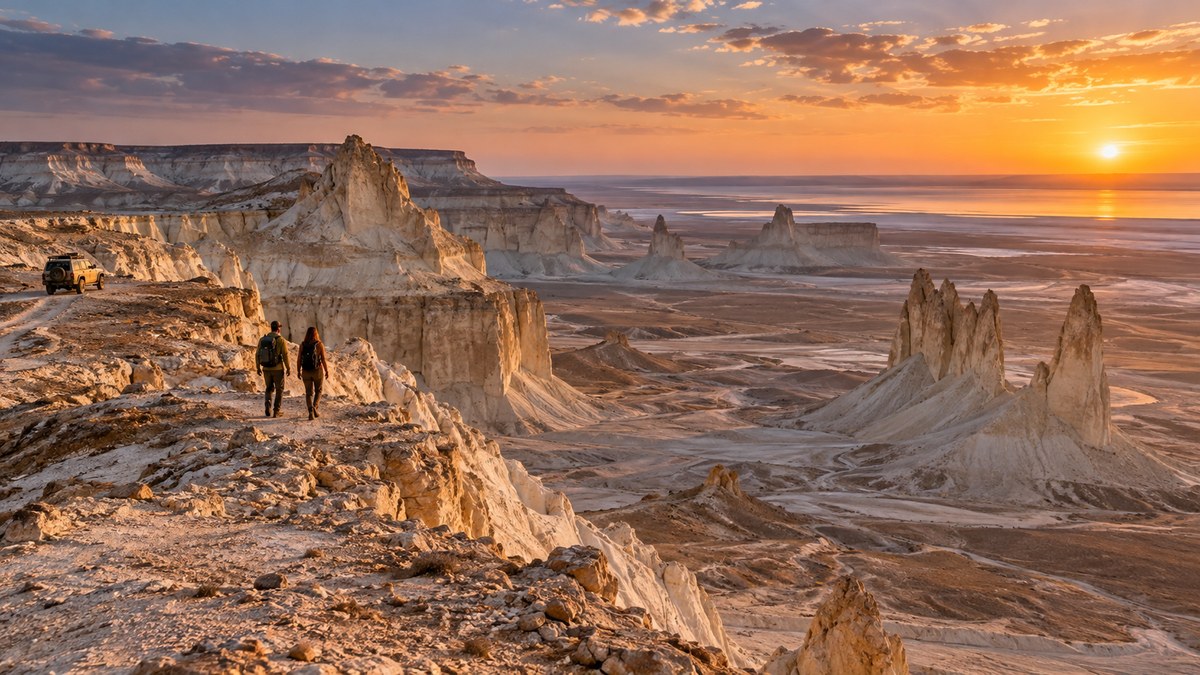
The Mangystau region in western Kazakhstan feels like a planet that forgot to finish forming. White chalk cliffs rise from flat desert floors. Limestone canyons twist into shapes that look like medieval castles. The Caspian Sea shimmers on the horizon while underground mosques carved into rock wait just off the main tracks. This is not a place you stumble upon. It is a place you choose to visit, and that choice rewards you with some of the most surreal landscapes on Earth.
The Mangystau desert is one of Kazakhstan’s most visually dramatic regions, offering otherworldly rock formations, ancient underground mosques, and vast empty spaces. Getting there requires flying into Aktau and then driving for several hours. A 4×4 vehicle is mandatory. The best months to visit are April through June and September through October. Plan for at least 5 to 7 days to see the main sights properly.
Why Mangystau Belongs on Your Kazakhstan Itinerary
Most travelers who visit Kazakhstan stick to the main cities. They see the futuristic skyline of Astana, walk through the green parks of Almaty, and maybe take a day trip to Charyn Canyon. That is a solid trip, but it barely scratches the surface. If you want to understand how vast and strange Kazakhstan really is, you need to head west.
The Mangystau desert covers an area roughly the size of Portugal. Its population density is among the lowest in Central Asia. That means you will often stand in a spot where the only sound is the wind. The rock formations here were shaped by an ancient sea that dried up millions of years ago, leaving behind limestone, chalk, and clay in colors ranging from pure white to deep red.
For adventure travelers who have already done the typical circuits in Southeast Asia or South America, Mangystau offers something genuinely different. It is raw, it is remote, and it feels undiscovered even though people have lived here for thousands of years.
Getting to the Mangystau Desert
The logistics of a Mangystau trip are not complicated, but they require planning. Here is how you get there.
Step 1: Fly to Aktau
Aktau is the gateway city. It sits on the Caspian Sea coast and has an international airport with flights from Astana, Almaty, and a few regional hubs like Baku and Istanbul. If you are coming from the United States, you will likely connect through Istanbul or Dubai.
Step 2: Arrange a Vehicle
This is the most important part of your planning. You cannot visit the Mangystau desert in a regular car. The roads are mostly unpaved tracks across salt flats, rocky plains, and sand. You need a 4×4 with high clearance. Many travelers book a private driver or join a small group tour. If you prefer to drive yourself, rent a UAZ or a Niva from a reputable agency in Aktau.
Step 3: Stock Supplies
There are no supermarkets or gas stations in the desert. Before you leave Aktau, buy enough drinking water for the entire trip (at least 5 liters per person per day). Also stock up on snacks, canned goods, and fuel. Most drivers will handle the fuel situation, but confirm this ahead of time.
Step 4: Download Offline Maps
Cell service in the Mangystau desert is unreliable. Google Maps works for the main roads but not for the off-road tracks. Download Maps.me or use a GPS app with offline satellite imagery. Your driver will likely know the routes, but having your own navigation is a good backup.
The Main Sights in the Mangystau Desert
The region has dozens of named landmarks. Here are the ones you should prioritize.
Bozzhyra (Bozjyra)
This is the postcard image of Mangystau. Bozzhyra is a canyon with massive white and orange cliffs that drop into a flat valley floor. The most famous viewpoint is called the Valley of Balls, where spherical rock formations sit scattered across the landscape. Sunrise and sunset here are spectacular because the low light turns the cliffs golden.
Torysh Valley (Valley of Balls)
Torysh is a separate location from Bozzhyra, though the name gets used interchangeably. This valley is filled with spherical ironstone concretions that look like cannonballs. Some are the size of basketballs. Others are as large as cars. Geologists still debate exactly how they formed.
Sherkala Mountain
This is a lone mountain that looks like a giant yurt or a medieval fortress. It rises abruptly from the flat desert floor and has a distinct layered appearance. Sherkala was once a caravanserai stop on the Silk Road. You can climb to the top, but the path is steep and loose.
Shakpak Ata Underground Mosque
This is not a natural formation, but it is one of the most atmospheric places in the region. The mosque was carved into a chalk cliff in the 10th century. Inside, you will find stone columns, prayer niches, and ancient inscriptions. The site is still used by local pilgrims. You need to remove your shoes before entering.
Karynzharyk (Karyn Zharyk)
This is a massive depression in the earth filled with white chalk hills. From a distance, it looks like a snowfield in the middle of the desert. Up close, the chalk creates a soft, almost lunar surface. The contrast between the white ground and the blue sky is stunning for photography.
Best Time to Visit the Mangystau Desert
The desert climate is extreme. Summers are brutally hot, with daytime temperatures often exceeding 100 degrees Fahrenheit. Winters are cold and windy, with occasional snow. The sweet spot is spring and fall.
| Season | Temperature Range | Conditions | Recommended? |
|---|---|---|---|
| Spring (April to June) | 60 to 80°F | Pleasant, some rain possible | Yes, best season |
| Summer (July to August) | 90 to 110°F | Very hot, dangerous for hiking | No |
| Fall (September to October) | 55 to 75°F | Cool and clear | Yes, best season |
| Winter (November to March) | 20 to 45°F | Cold, windy, short daylight | Possible but tough |
If you visit in spring, expect some wildflowers in the lower areas. In fall, the light is softer and the skies are usually cloudless.
What to Pack for the Mangystau Desert
Your packing list should focus on sun protection, hydration, and layers.
- Wide brim hat or a cap with a neck flap
- UV blocking sunglasses
- Sunscreen with SPF 50 or higher
- Lightweight long sleeve shirts (for sun protection)
- A warm jacket or fleece (mornings and evenings are cold even in summer)
- Sturdy hiking boots with ankle support
- A headlamp (for exploring caves and underground mosques)
- Reusable water bottles or a hydration bladder
- Electrolyte packets
- A basic first aid kit
- Toilet paper and hand sanitizer
- A power bank for charging devices
Local guide advice: “Bring a scarf or a buff. When the wind picks up, the sand and dust get everywhere. Covering your mouth and nose makes the day much more comfortable.”
How Many Days Do You Need?
The Mangystau desert is not a place you visit for a single day. The distances between sights are large, and the driving is slow. Here is a realistic breakdown.
- Day 1: Arrive in Aktau. Pick up supplies and meet your driver. Drive to your first camp or guesthouse near the desert edge.
- Day 2: Visit Shakpak Ata mosque and the surrounding chalk cliffs. Drive toward Sherkala.
- Day 3: Explore Sherkala and Torysh Valley. Stay overnight near Bozzhyra.
- Day 4: Full day at Bozzhyra. Hike the canyon rim and visit the Valley of Balls.
- Day 5: Drive to Karynzharyk and other southern formations. Return toward Aktau.
- Day 6: Buffer day for unexpected delays or extra hiking.
- Day 7: Return to Aktau and fly out.
If you only have five days, you can skip the buffer day and move faster, but the experience will feel rushed.
Where to Stay in the Desert
There are no hotels in the Mangystau desert. Accommodation options fall into three categories.
- Camping: Many travelers bring their own tents or sleep in yurts set up by local tour operators. Camping gives you the best access to sunrise and sunset views.
- Guesthouses: A few small villages near the desert have basic guesthouses. Expect shared bathrooms, simple beds, and home cooked meals.
- Aktau day trips: Some operators offer day trips from Aktau, but these only cover the closest sights. You will miss the best parts of the desert.
Camping is the most immersive option. If you are not comfortable sleeping in a tent, book a tour that provides yurt accommodation.
Safety and Practical Tips
The Mangystau desert is safe in terms of crime, but the environment itself demands respect.
- Do not hike alone. The terrain is disorienting, and landmarks look different from different angles.
- Watch for snakes. Central Asian vipers and sand boas live in the region. They are not aggressive, but watch where you step.
- Stay hydrated. Dry air and wind can dehydrate you without you noticing. Drink water even if you do not feel thirsty.
- Tell someone your plans. If you are driving yourself, share your itinerary with a contact in Aktau.
- Respect the mosques. Shakpak Ata and other religious sites require modest clothing. Women should cover their heads inside.
For more general safety advice, read our guide on is Kazakhstan safe for tourists. It covers the common concerns most visitors have.
Common Mistakes Travelers Make
Avoid these errors to keep your trip smooth.
- Underestimating driving times: A distance that looks short on a map can take three hours on a dirt track.
- Forgetting cash: Most desert guides and guesthouses do not accept cards. Bring enough tenge to cover your entire trip.
- Skipping the offline maps: Phones lose signal constantly. A downloaded map can save you hours of backtracking.
- Not bringing enough water: You cannot buy water in the desert. Run out, and your trip becomes a serious emergency.
- Wearing new boots: Blisters will ruin your hiking. Break in your footwear before you arrive.
Connecting Mangystau to the Rest of Your Kazakhstan Trip
Many travelers combine a Mangystau trip with time in Astana or Almaty. The flight from Astana to Aktau takes about three hours. From Almaty, it is about four hours. Plan your domestic flights carefully because schedules can change.
If you are building a longer itinerary, consider adding a stop in Turkestan on your way west. The mausoleum of Khoja Ahmed Yasawi is a UNESCO World Heritage site and sits roughly halfway between Astana and Aktau.
For a deeper look at the entire Caspian coast region, including Aktau and other nearby landscapes, check out our complete guide to Kazakhstan’s Caspian coast.
Budgeting for a Mangystau Trip
The costs are lower than you might expect. Here is a rough estimate for a seven day trip.
| Item | Cost (USD) |
|---|---|
| Domestic flight (round trip) | $100 to $180 |
| 4×4 rental with driver (per day) | $80 to $130 |
| Camping or guesthouse (per night) | $10 to $30 |
| Food and water (per day) | $15 to $25 |
| Guide fee (optional, per day) | $30 to $50 |
Total for a solo traveler with a driver and basic accommodation: roughly $700 to $1,000 for the week. If you split the driver cost with one or two other people, the price drops significantly.
Your Mangystau Adventure Starts with One Decision
The Mangystau desert does not market itself. There are no billboards, no visitor centers with glossy brochures, and no Instagram influencers staging photoshoots at every corner. The region remains quiet and honest. What you see is what you get: ancient rock, open sky, and the kind of silence that settles into your bones.
If you are the type of traveler who gets more excited by an empty road than a crowded square, this is your place. Book your flight to Aktau, find a reliable driver, and give yourself at least a week. The desert will do the rest.