
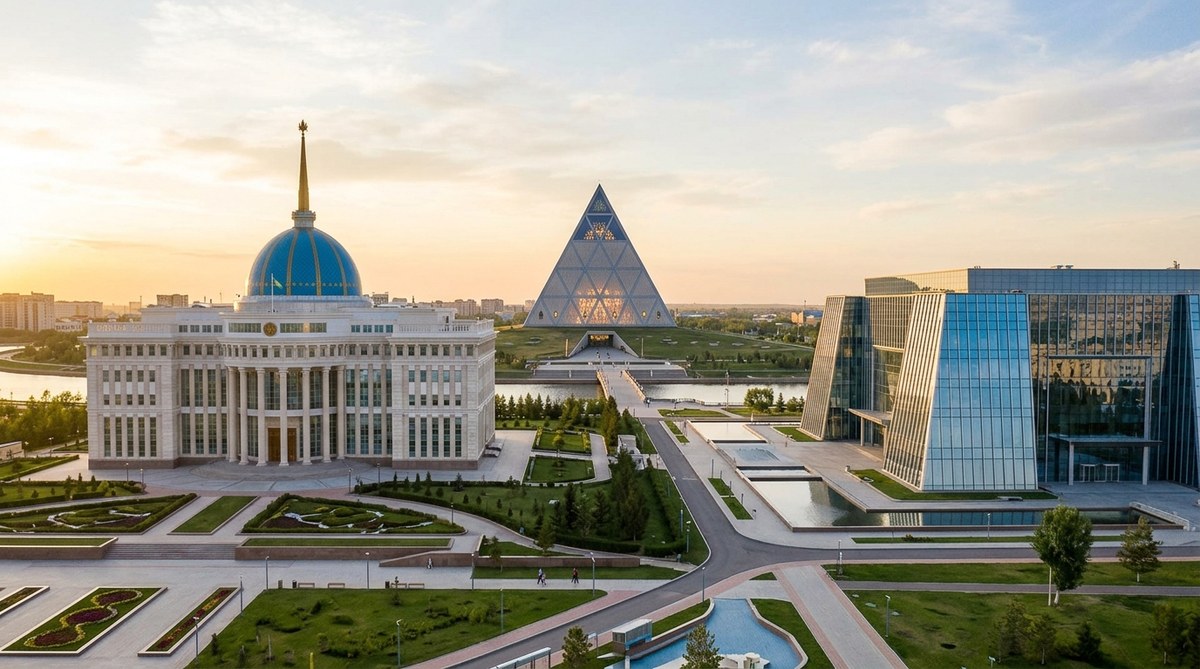
Astana is a city that wears its ambition on its sleeve. You see it the moment you cross the Ishim River into the Left Bank district. The skyline rises like a science fiction set, but it is not random. Every golden dome, every sharp angle, every glittering tower was placed there with purpose. At the heart of this urban stage sit three buildings that do more than house government business. They tell the story of a young nation trying to define itself. These are the presidential palaces of Astana, and together they form a triad of political architecture that redefines how a capital city can project power.
Astana’s three presidential palaces are not just offices. They are a deliberate architectural trilogy that charts Kazakhstan’s journey from Soviet republic to independent nation. The Ak Orda Palace, the Palace of Independence, and the Palace of Peace and Reconciliation each use distinct styles to communicate authority, openness, and a future-facing identity. Understanding them unlocks the entire city.
The Triad That Tells a Story
Most capital cities have one presidential palace. Astana has three. That alone tells you this is not a normal place. Each building serves a different function, but together they create a conversation about power, history, and national identity. The trio sits along the main axis of the Left Bank, forming a straight line that you can walk in under an hour. This was no accident. The master plan for Astana, designed by Japanese architect Kisho Kurokawa, used this axis to create a ceremonial spine for the city.
The three palaces are:
- Ak Orda Presidential Palace (the working residence of the president)
- Palace of Independence (a venue for state events and conferences)
- Palace of Peace and Reconciliation (a pyramid shaped congress hall for global dialogue)
Each one speaks a different architectural language. Together, they form a complete statement about what Kazakhstan wants to be.
Ak Orda: The Blue and Gold Power Center
Ak Orda means “White Horde” in Kazakh, a reference to the medieval Khanate that once ruled this land. The building itself is a study in classical authority. A massive blue dome sits on a rectangular base, flanked by columns and covered in gold accents. It looks like a cross between a neoclassical capitol building and something from the Arabian Nights.
The choice of blue and gold is not decorative. Blue represents the sky and the Kazakh flag. Gold references the wealth of the steppe and the country’s vast mineral resources. When you stand in front of Ak Orda, you are meant to feel stability and tradition. The building says, “We are a serious nation with deep roots.”
You cannot go inside unless you have official business, but the exterior is worth a long look. The symmetry is perfect. The proportions are grand. It anchors the entire government quarter. For anyone interested in Astana political architecture, this is ground zero.
Palace of Independence: Transparency and Glass
Walk five minutes south from Ak Orda and you reach the Palace of Independence. The contrast is immediate. Where Ak Orda is heavy and traditional, this building is light and open. A vast glass facade lets you see straight through the structure. At night, it glows like a lantern.
This building was designed for the people. It hosts exhibitions, conferences, and public ceremonies. The transparent walls are a deliberate message. The government wants to be seen as open and accessible. The Palace of Independence is where Kazakhstan shows off its modern side to the world.
Inside, the main hall can seat over 2,000 people. The ceilings are high, the lines are clean, and the materials are contemporary steel and glass. It feels more like an airport terminal in Singapore than a government building in Central Asia. That is the point. Kazakhstan wants to be seen as a global player, not a relic of the Soviet past.
Palace of Peace and Reconciliation: The Pyramid
The third member of the triad is the strangest and most famous. The Palace of Peace and Reconciliation is a 62 meter tall pyramid designed by British architect Norman Foster. It sits at the southern end of the axis, completing the line.
Why a pyramid? Foster said the shape represents equality. A pyramid has no top floor or bottom floor in the traditional sense. Every level is equal. The building was created as a venue for the Congress of Leaders of World and Traditional Religions, a gathering that brings together faiths from around the globe.
The pyramid is covered in a lattice of gray stone and glass. At the top, a stained glass window by artist Brian Clarke fills the apex with colored light. The effect is cathedral like, but the building is not a religious structure. It is a political statement about tolerance and dialogue.
You can visit the inside. The ground floor has a concert hall and exhibition spaces. An elevator takes you to the top, where you can look out over the entire city. The view is worth the trip. From here, you see the full arc of the Left Bank, with Ak Orda and the Palace of Independence lined up like beads on a string.
How to See All Three in One Morning
You do not need a tour guide to experience this architectural trilogy. The walk is straightforward and takes about two hours at a relaxed pace.
- Start at Ak Orda. Stand at the main gate on the river side. Take photos of the dome and the gold statuary. Look for the guards in their dress uniforms.
- Walk south along the central pedestrian boulevard. Pass the fountain and the manicured lawns. This is the ceremonial route used for state processions.
- Stop at the Palace of Independence. Enter the lobby if it is open to the public. Check the schedule for any exhibitions.
- Continue south to the pyramid. Buy a ticket for the elevator ride to the top. Spend time in the stained glass light at the apex.
- End at the park behind the pyramid. Turn around and look back. You will see all three buildings in one frame.
What the Architecture Says About Power
Political architecture is never neutral. Every column, every material, every sightline is chosen to create a feeling. The triad in Astana uses three different strategies to build authority.
| Building | Strategy | Visual Message |
|---|---|---|
| Ak Orda | Classical tradition | Stability, continuity, heritage |
| Palace of Independence | Modern transparency | Openness, progress, public access |
| Palace of Peace | Futuristic symbolism | Global ambition, neutrality, dialogue |
Together, they cover all the bases. Kazakhstan wants to be seen as ancient and modern, traditional and forward thinking, local and global. The architecture says all of that without using a single word.
“Astana’s architecture is not just about looking impressive. It is about telling a story of sovereignty. When you move the capital from Almaty to a new city in the middle of the steppe, you have to build a visual language that explains why.” — Local architecture guide, Astana
Why This Matters for Visitors
If you only care about selfies, the palaces are beautiful backdrops. But if you want to understand Kazakhstan, this is where the country reveals itself. The triad is a physical map of national psychology. It shows you what the government values, how it wants to be seen, and where it thinks it is going.
For architecture enthusiasts, this is a rare case study. Few cities have built a complete government quarter from scratch in the last 30 years. Astana offers a living laboratory of how post Soviet states use urban design to create identity.
For political science students, the triad is a textbook example of soft power. No bombs. No threats. Just buildings that change how people think about a nation.
Practical Tips for Your Visit
- Best light: Early morning for Ak Orda (the gold catches the sunrise). Late afternoon for the pyramid (the glass reflects warm tones).
- Entry fees: The Palace of Peace charges a small fee for the elevator. The other two are free to view from outside.
- Security: Expect bag checks at the Palace of Peace. Do not bring large backpacks.
- Nearby stops: After the triad, walk to the Bayterek Tower for a panoramic view. You can read our guide on the complete guide to visiting Bayterek Tower without the tourist crowds for tips on timing.
- Combine with: The National Museum is a short walk from the pyramid. It helps fill in the historical context behind the buildings.
How the Triad Redefines Political Architecture
Most presidential palaces are single buildings. They sit behind walls and gates. You see them from a distance and feel small. Astana does something different. By spreading power across three buildings, the city creates a conversation rather than a monolith. The pyramid speaks to the palace. The glass hall speaks to the golden dome. Each building checks the others.
This is a new model for political architecture. It acknowledges that power in the 21st century is not just about authority. It is also about dialogue, transparency, and global engagement. Astana’s triad says, “We are strong, but we are also open. We have history, but we are building the future.”
Few cities have pulled this off. Washington D.C. has the Capitol, the White House, and the Supreme Court, but they were built over centuries. Astana built its triad in less than two decades. That speed gives the whole project a feeling of intention.
The Real Story of Astana Political Architecture
Some travelers come to Astana expecting a gimmick. They think the futuristic buildings are just showpieces for an oil rich government. Spend a day walking the Left Bank axis, and you will change your mind. The architecture is not a gimmick. It is a manifesto.
The triad of presidential palaces redefines political architecture by proving that buildings can do more than house meetings. They can shape identity, project values, and tell a story to the world. Kazakhstan used concrete, glass, and gold to write its own declaration of independence.
When you stand at the base of the pyramid and look north toward Ak Orda, you are standing in the middle of that story. It is a story about a nation that chose to build itself from scratch on an empty plain. That takes vision. That takes nerve. And it makes for one of the most compelling architectural experiences on the planet.
Your Next Step in Astana
Now that you understand the triad, go see it in person. The walk is easy. The buildings are free to view. And the experience will change how you think about what a capital city can be. After you finish the axis, consider our walking guide for the ultimate walking tour of Astana’s futuristic Left Bank district to catch the landmarks you might have missed. Pack comfortable shoes, bring your camera, and give yourself permission to stare. That is what these buildings were made for.