
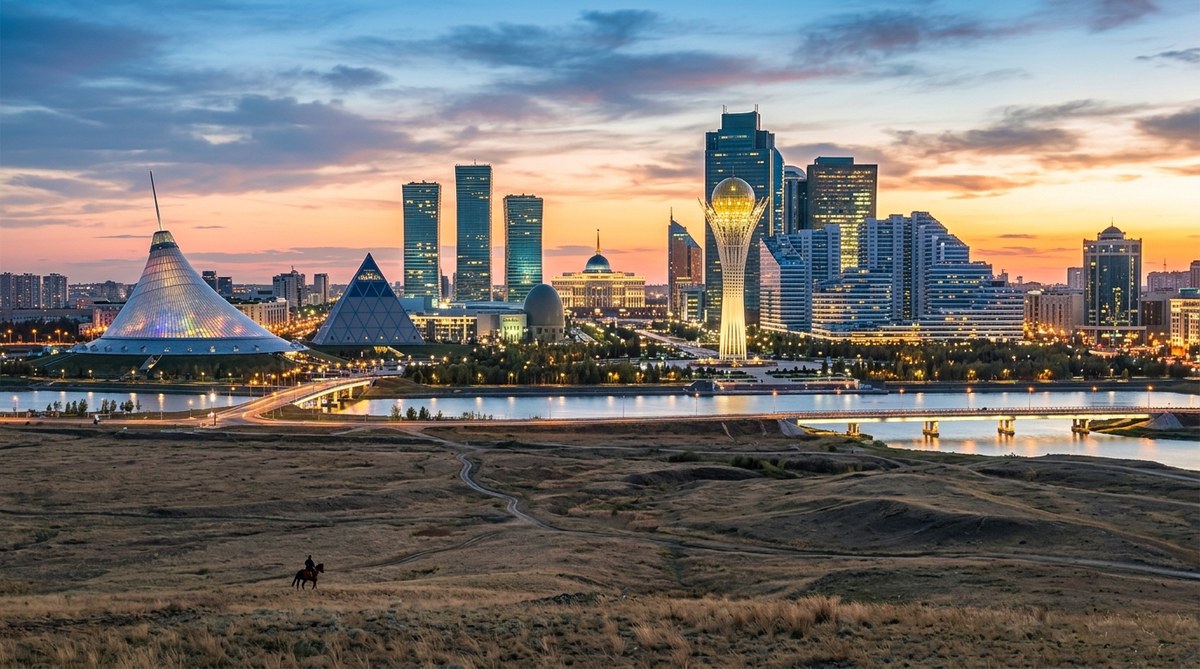
Picture a flat, windswept grassland that stretches to the horizon. Now imagine a gleaming city of glass, gold, and bizarre geometric shapes rising from that emptiness. That is the story of Astana’s skyline transformation. In 1997, Kazakhstan’s president made a bold decision. He moved the capital from Almaty, a city nestled in the foothills of the Tian Shan mountains, to a small provincial town called Akmola on the barren northern steppe. The town had about 300,000 residents and almost no modern architecture. Two decades later, that same spot holds a skyline that looks like a movie set for a futuristic utopia. How did this happen? And why should you care enough to book a flight?
Astana’s skyline transformation is one of the most ambitious urban planning projects of the 21st century. The city went from a sleepy steppe town to a capital with over 1.4 million people and a skyline designed by the world’s top architects. You can see this evolution in a single day by walking the Left Bank’s main axis. The buildings are not just flashy. They are loaded with symbolism that mixes Kazakh nomadic traditions with a vision of the future. Understanding this story makes your visit ten times more rewarding.
The Blank Canvas of the Steppe
When the capital moved, architects faced a rare challenge. They had to build a capital city from scratch on an empty piece of land. There were no historic districts to preserve, no old buildings to work around. The steppe was a blank slate. This freedom is what makes the Astana skyline transformation so unique. Most world capitals grow slowly over centuries. Astana was designed and built in a generation.
The first phase of construction focused on the Left Bank, the newer part of the city west of the Ishim River. Planners drew a long central axis, now called Nurzhol Boulevard, and lined it with the most important government buildings and monuments. This layout is not accidental. It mirrors the design of other planned capitals like Washington, D.C. and Brasilia. But the style is pure Kazakh futurism.
The Architects Behind the Miracle
You cannot talk about the Astana skyline transformation without naming the people who drew the plans. The city became a magnet for starchitects. Norman Foster designed the iconic Palace of Peace and Reconciliation, a giant pyramid made of glass and steel. Kisho Kurokawa, the famous Japanese metabolist architect, designed the main railway station. The Khan Shatyr Entertainment Center, a massive translucent tent that houses an indoor beach, was designed by the British firm Foster + Partners as well.
These architects were given unusual freedom. President Nursultan Nazarbayev reportedly told them to create something that would make the world look at Kazakhstan. They delivered.
A Quick Look at the Key Players
| Architect | Building | Style | Year Completed |
|---|---|---|---|
| Norman Foster | Palace of Peace and Reconciliation | Pyramid, glass and steel | 2006 |
| Kisho Kurokawa | Astana Railway Station | Metabolist, futuristic | 2008 |
| Foster + Partners | Khan Shatyr | Giant tensile membrane tent | 2010 |
| Manfredi Nicoletti | Kazakhstan Central Concert Hall | Organic, wave-like | 2009 |
| Various (Chinese firms) | Abu Dhabi Plaza | Mixed-use skyscraper complex | 2022 |
The Symbolism That Shapes the Skyline
The Astana skyline transformation is not just about looking cool. Every major building carries a symbolic meaning rooted in Kazakh culture and history.
The most famous example is the Bayterek Tower. It stands 97 meters tall, a number chosen because the capital moved in 1997. The tower represents a tree from Kazakh mythology. At the top, a golden orb holds a wooden bowl with an imprint of the president’s right hand. Visitors place their hand in the imprint and make a wish. The view from the top gives you the best possible perspective on the entire Astana skyline transformation.
The Palace of Peace and Reconciliation is shaped like a pyramid. It was built to host the Congress of Leaders of World and Traditional Religions. The pyramid shape was chosen to represent unity and transparency. Inside, a 1,500-seat opera house and a museum sit beneath a stained-glass dove ceiling made by artist Brian Clarke.
The Khan Shatyr is shaped like a giant tent. This is a direct reference to the yurt, the portable home of Kazakh nomads. Inside this tent, you can swim in a beach club while the temperature outside drops to minus 30 degrees Celsius in winter.
How to See the Transformation in One Day
You can witness the full Astana skyline transformation on foot. Here is a practical walking route.
- Start at Bayterek Tower. Take the elevator to the golden orb. Spend 30 minutes looking at the city from above. This gives you the context for everything else.
- Walk south down Nurzhol Boulevard. This is the central axis. You will pass fountains, flower beds, and sculptures. Look to your left and right at the government buildings.
- Stop at the Palace of Peace and Reconciliation. Go inside if you have time. The pyramid is only a 10 minute walk from Bayterek.
- Continue to the Khan Shatyr. This is about a 20 minute walk further south. Enter the tent and see the indoor beach. Even if you do not swim, the scale of the structure is impressive.
- Cross the Ishim River to the Right Bank. The older part of the city has a completely different feel. It is less flashy but more lived in. This contrast shows you how much the Left Bank changed the city.
For a more detailed route with insider tips, read our guide on the ultimate walking tour of Astana’s futuristic Left Bank district.
The Three Phases of Construction
The Astana skyline transformation happened in three distinct waves.
- Phase 1 (1997 to 2005): The government moved in. Basic infrastructure was built. The first iconic buildings, like Bayterek, went up.
- Phase 2 (2006 to 2014): The starchitects arrived. The Palace of Peace, Khan Shatyr, and the concert hall were built. The skyline became truly international.
- Phase 3 (2015 to present): The city filled in. Skyscrapers like the Abu Dhabi Plaza towers and the Ritz-Carlton hotel rose. The skyline became denser and more vertical.
Each phase added a new layer to the city’s identity. Today, Astana has over 1.4 million residents. The population is still growing.
The Controversy Behind the Glass
No honest discussion of the Astana skyline transformation can ignore the criticism. Some urban planners call the city a Potemkin village, a facade of wealth hiding deeper problems. The Left Bank can feel empty. Wide boulevards and massive plazas are not always filled with people. The city’s brutal winters keep many indoors for half the year.
There is also the question of cost. The construction of Astana cost billions of dollars. Some critics argue that money could have been spent on schools, hospitals, or infrastructure in other parts of the country.
But defenders of the project say the investment paid off. Astana put Kazakhstan on the map. It attracted foreign investment, hosted the EXPO 2017 world’s fair, and became a symbol of national pride. The city is now a destination for architecture enthusiasts from around the world.
“Astana is not a city. It is a statement. It says that Kazakhstan is not a backward steppe nation. It is a modern, ambitious country that belongs in the 21st century.” – Local architect quoted in a 2019 interview
What Makes This Skyline Different from Dubai or Doha
People often compare Astana to other cities built with oil money. Dubai and Doha also rose from the desert with flashy skyscrapers. But the Astana skyline transformation has a different character.
Dubai’s skyline is about luxury and excess. Astana’s skyline is about symbolism and national identity. The buildings in Astana are not just tall. They are meaningful. The Bayterek tower is not just a landmark. It is a myth made concrete. The Khan Shatyr is not just a mall. It is a tribute to nomadic heritage.
Also, Astana is far smaller. The skyline is concentrated on the Left Bank. You can see most of it in a single walk. Dubai’s skyline stretches for miles and can feel overwhelming. Astana’s feels intentional and comprehensible.
The Best Spots for Photography
If you want to capture the Astana skyline transformation for your camera, you need to know the right spots.
- Bayterek Tower observation deck: The classic shot. Best at sunset when the golden orb reflects the light.
- The bridge across the Ishim River near the Palace of Independence: This gives you a view of both banks. The contrast between old and new is stark here.
- The rooftop of the Ritz-Carlton hotel: You need to be a guest or have a dinner reservation, but the view is worth it. You can see the entire Left Bank skyline in one frame.
- Nurzhol Boulevard at night: The buildings light up in different colors. The Khan Shatyr glows blue and green. This is a magical time to walk.
For more photography tips, check out our guide on how to photograph Astana’s golden towers like a professional.
The Future of the Skyline
The Astana skyline transformation is not finished. The city is still growing. New residential towers are rising in the Left Bank. The EXPO 2017 site has been repurposed into the Astana International Financial Centre, a hub for business and finance. The Nur Alem sphere, the largest spherical building in the world, now houses a museum about future energy.
Plans for the next decade include more green spaces, better public transport, and higher density development. The goal is to make the Left Bank feel less empty and more like a real city. The skyline will keep changing.
If you want to see buildings that most tourists miss, read our article on 7 hidden architectural gems in Astana that most tourists miss.
Your Skyline Transformation Checklist
Here is a simple checklist to make sure you see the best of the Astana skyline transformation.
- Visit Bayterek Tower at sunset for the view and the photo.
- Walk the full length of Nurzhol Boulevard, from Bayterek to Khan Shatyr.
- Go inside the Khan Shatyr and see the beach.
- Cross the river to the Right Bank and look back at the skyline.
- See the Palace of Peace and Reconciliation lit up at night.
- Visit the Nur Alem sphere at the EXPO site.
- Eat dinner at a restaurant with a skyline view, like the one in the Ritz-Carlton.
Why You Should Book the Trip Now
Astana’s skyline transformation is a once in a generation event. You can still see the city in its current form, a mix of brand new towers and empty lots that will soon be filled. In another decade, the skyline will be denser and more mature. The raw energy of the construction phase will be gone.
Travel to Kazakhstan is easier than ever in 2026. The visa process is simple for most nationalities. Flights from major European and Asian hubs are affordable. The city is safe, clean, and welcoming to tourists. English is spoken in hotels and restaurants near the Left Bank.
If you love architecture, urban planning, or just seeing places that feel like they are from another planet, Astana belongs on your list. The steppe turned into a sci-fi movie set in just twenty years. That is a story worth seeing with your own eyes.