
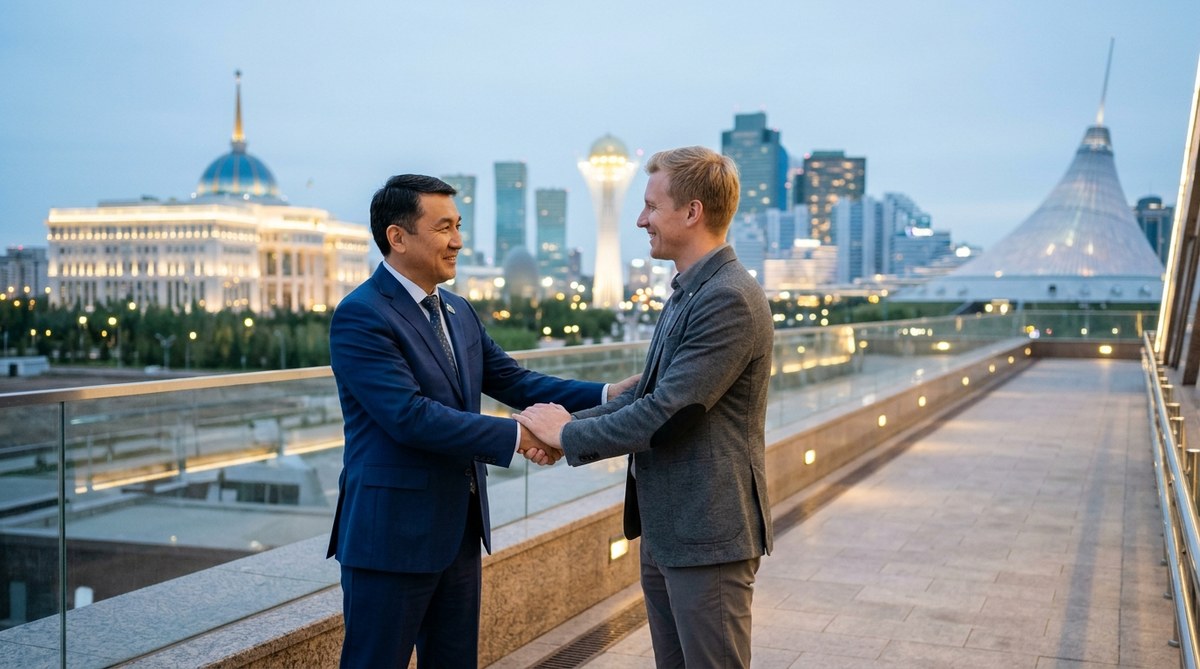
You step off the plane at Nursultan Nazarbayev International Airport, and within minutes you are meeting someone new. You extend your right hand, ready for the standard American grip you have used a thousand times. But the hand that meets yours wraps around it in a way that feels different. It is warmer. It lasts a second longer. And then the person places their left hand over the joined grip. You have just experienced a Kazakh handshake, and it already told the other person more about you than you realize.
The Kazakh handshake is not a simple greeting. It is a ritual that communicates respect, trust, and social awareness. The two-handed grip, the eye contact, and the slight nod all carry meaning. Foreigners who master this greeting earn immediate cultural credibility. This guide covers the proper technique, the common mistakes, and the deeper values behind the gesture so you can walk into any meeting in Astana with confidence.
Why a Handshake Matters More Than You Think
In Kazakhstan, greetings are not throwaway motions. They are the opening statement of your character. The way you shake hands tells a Kazakh counterpart whether you respect their traditions, whether you understand hierarchy, and whether you can be trusted.
This is especially true in Astana, the capital city where business culture blends Soviet-era formality with Kazakh nomadic hospitality. A weak, one-handed shake can brand you as careless. A firm, two-handed grip signals that you are someone worth knowing.
Kazakh handshake etiquette draws from two deep roots: the nomadic tradition of showing you carry no weapons (an open, two-handed approach) and the Soviet influence of firm, direct greetings. The result is a handshake that feels both personal and formal at the same time.
The Anatomy of a Proper Kazakh Handshake
Let us break down the physical mechanics so you can practice before your trip.
The Two-Handed Grip
This is the defining feature. You shake with your right hand, but your left hand supports the gesture. Here is how it works:
- Extend your right hand as you normally would.
- When the other person’s hand meets yours, wrap your left hand around the back of their right hand or around the joined hands.
- Hold the grip for a moment longer than a Western handshake, about two to three seconds.
- Make direct eye contact and give a slight nod of the head.
The left hand should not squeeze. It rests gently on the back of the other person’s hand. This gesture says, “I am greeting you with both hands because you matter to me.”
The One-Handed Exception
You will sometimes receive a one-handed handshake. This is common in casual settings or between younger people. But if the person you are meeting is older or holds a senior position, always offer the two-handed grip. They will notice.
The Handshake Table
| Situation | Technique | Meaning |
|---|---|---|
| Meeting an elder or boss | Two-handed grip, hold 3 seconds, nod | Deep respect |
| Meeting a peer in business | Two-handed grip, firm, 2 seconds | Professional trust |
| Casual greeting with a friend | One-handed grip, brief | Familiarity |
| First meeting at a social event | Two-handed grip, warm smile | Openness |
| Formal ceremony or official event | Two-handed grip, slight bow of head | High formality |
Common Mistakes That Undermine Your Greeting
Even well-meaning travelers make these errors. Avoid them to keep your first impression strong.
- A limp handshake. A weak grip reads as disinterest or lack of confidence. Your handshake should be firm but not crushing.
- Pulling your hand away too fast. Kazakhs hold the handshake longer than Westerners. If you pull away after one second, you seem rushed or uncomfortable.
- Ignoring hierarchy. Shake hands with the oldest or most senior person first. Walking past an elder to greet a younger colleague is a serious breach.
- Using only your right hand. The one-handed shake is acceptable in some cases, but the two-handed version is always safer.
- Breaking eye contact. Looking away during the handshake signals dishonesty or nervousness. Hold eye contact through the entire greeting.
- Shaking across a threshold. In Kazakh tradition, shaking hands over a doorway or threshold is considered bad luck. Wait until you are fully inside the room.
How to Navigate Group Greetings
You walk into a meeting room in Astana and see five people. Do you shake each hand individually? Yes. You absolutely do.
Here is the correct order:
- Greet the oldest person in the room first.
- Move to the next senior person.
- Continue down the hierarchy by age and position.
- Shake hands with everyone, even if there are ten people.
Do not skip anyone. Do not wave at the group from across the table. Kazakhs consider it rude to leave someone out of the greeting circle. This takes time, but it shows you respect each person present.
Women should note that some conservative Kazakh men may wait for the woman to extend her hand first. If a man does not offer his hand, a slight nod and a verbal greeting are appropriate.
The Deeper Cultural Message
Why do Kazakhs care so much about a handshake? The answer lies in the nomadic heritage of the steppe.
For centuries, Kazakh nomads lived in isolated communities spread across vast grasslands. When two travelers met, the greeting was a moment of high stakes. Was this person a friend or a threat? The two-handed shake evolved as a way to show you were unarmed and approaching in peace. The left hand on the grip proved you were not hiding a weapon.
That history still echoes today. A Kazakh handshake says, “I come in peace. I respect you. I am trustworthy.”
This is also why the handshake is warmer and more personal than in many Western cultures. It is not a transaction. It is a human connection.
“In Kazakhstan, the handshake is the first verse of a conversation. If you sing it wrong, the whole song feels off.” – Aigerim S., cultural etiquette trainer based in Astana
Adapting Your Handshake for Different Settings
Business Meetings
In a corporate setting in Astana, the handshake follows strict protocol. The two-handed grip is standard. Bring business cards to exchange after the handshake, and present yours with both hands. This mirrors the two-handed respect of the greeting.
Social Gatherings
At a dinner or party, the handshake is slightly more relaxed but still warm. You may find yourself shaking hands with everyone upon arrival and again when you leave. This is normal. Do not skip the farewell round.
Formal Events
At weddings, official ceremonies, or cultural celebrations like Nauryz, the handshake may include a slight bow. Men sometimes place their left hand over their heart instead of over the joined hands. Follow the lead of the host.
When You Cannot Shake Hands
If your hands are full or you are eating, a nod and a hand over your heart is an acceptable alternative. If you are sick, it is polite to apologize and explain rather than risk passing illness through the greeting.
A Step-by-Step Guide to Your First Kazakh Handshake
- Approach with a smile. Warmth is expected.
- Identify the most senior person. Make eye contact with them first.
- Extend your right hand. Keep it at a natural height, not too high or low.
- Meet their grip. As your hands connect, bring your left hand to the back of their hand.
- Hold for two to three seconds. Do not rush.
- Say “Salamatsyz ba?” (Are you healthy?) or “Khalyngyz khalai?” (How are you?) in Kazakh. In Russian, “Zdravstvuyte” works well.
- Nod your head slightly. A full bow is not needed, but a small nod shows respect.
- Release gently. Let your hands separate naturally.
- Repeat with the next person. Move down the line by age or rank.
What Your Handshake Communicates About You
Your handshake is a mirror. It reflects your preparation, your cultural awareness, and your attitude toward the people you meet.
- A firm two-handed grip with eye contact says: “I did my homework. I respect your culture. I am serious.”
- A weak one-handed shake says: “I am uncomfortable. I did not prepare. I am not fully present.”
- A crushing grip says: “I am trying too hard to prove something.”
- A handshake with a smile says: “I am glad to be here.”
- A handshake without a smile says: “This is a transaction, not a relationship.”
Kazakhs value relationship above transaction. Your handshake sets the tone for everything that follows.
Handshake Etiquette Across Kazakhstan’s Regions
Astana, as the capital, follows a more formal and business-oriented style. Almaty, the former capital, is slightly more relaxed. Rural areas and villages hold the traditional two-handed grip even more strictly.
If you travel to Shymkent or Turkestan in the south, expect the handshake to be warmer and longer. Southern Kazakhs are known for their expressive hospitality. In the western regions like Aktau, the handshake may include a brief hug between men who know each other well.
Adapt to the local rhythm. When in doubt, mirror what your host does.
How to Recover from a Handshake Mistake
You will probably make a mistake. That is okay. Kazakhs are generally forgiving toward foreigners who try to respect their customs.
If you forget the two-handed grip and offer a one-handed shake, simply apologize: “Keshirinzhe, men zhana adetke uyrenip zhatyrmyn” (Forgive me, I am still learning the customs). Most Kazakhs will smile and appreciate your effort.
If you shake hands with the wrong person first, acknowledge the senior person with a nod and apologize. Do not make a big scene. Just adjust and continue.
The Handshake Beyond the Greeting
The values you show in your handshake carry through the rest of your interaction. Kazakhs notice consistency. If you greet someone with a warm, respectful handshake but then act dismissively during the conversation, the handshake loses its meaning.
Your handshake is a promise. It promises that you will be respectful, attentive, and trustworthy. Keep that promise.
This is why understanding Kazakh handshake etiquette is not just about the mechanics. It is about understanding that in Kazakhstan, relationships are built slowly and carefully. The handshake is the first brick in that foundation.
Bringing Respect Into Every Greeting
You now know more than most travelers about this essential piece of Kazakh etiquette. Before your trip to Astana, practice the two-handed grip with a friend. Time yourself. Aim for a three-second hold. Look the person in the eye. Nod once.
When you arrive and meet your first Kazakh colleague, host, or new friend, you will not be guessing. You will be greeting them the right way. And they will remember you for it. That small moment of cultural fluency opens doors to better conversations, stronger business relationships, and deeper travel experiences across Kazakhstan.