
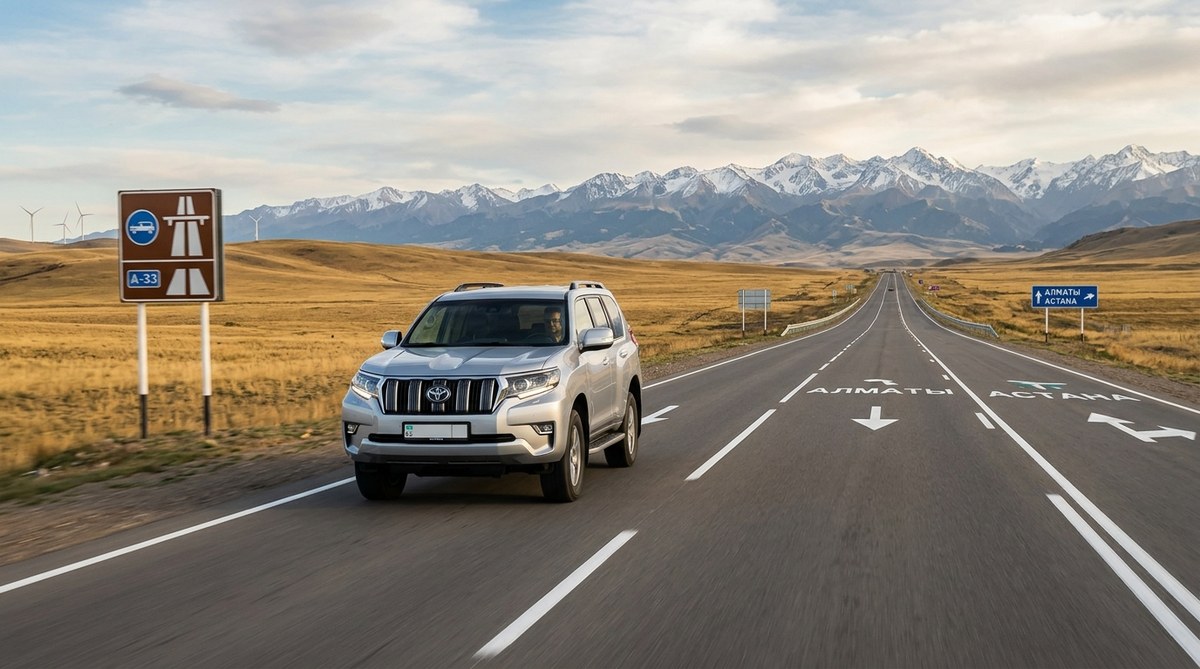
You have just moved to Astana. The city’s futuristic skyline glows through your apartment window, and you are ready to explore beyond the bus routes. You could call a Yandex Taxi every time, but something about having your own set of wheels feels right. Freedom. Spontaneous weekend trips to Burabay. A trunk full of groceries from the Magnum without hauling bags up three flights of stairs.
Driving in Kazakhstan is different from driving in the United States or Europe. The rules are similar on paper, but the reality on the road requires a shift in mindset. This guide covers everything you need to know as an expat: license requirements, road conditions, traffic laws, and the step-by-step process for renting a car.
Expats can drive in Kazakhstan with a valid foreign license for up to one year, but you must carry your passport and registration documents at all times. Road conditions vary wildly: smooth highways in Astana give way to potholed rural roads. Winter tires are mandatory from December 1 to March 1. Rental cars are affordable, but insurance coverage requires careful attention.
Your Driver’s License: What Works and What Doesn’t
Kazakhstan allows foreign residents to drive using a valid driver’s license from their home country for up to one year after arrival. This applies to licenses issued in the United States, Canada, the UK, and most European countries.
After that one-year mark, you need to obtain a Kazakhstani driver’s license. The process involves passing a theory test (available in Russian or Kazakh) and a practical driving exam. There is no automatic reciprocity, so even if you have a clean record back home, you still take the test.
An International Driving Permit (IDP) is not strictly required for license validation, but it is highly recommended. Police officers are more familiar with the IDP format, and it provides a translation of your credentials. If your home license is not in Russian or English, an IDP becomes essential.
What to carry in the car at all times:
- Your passport (with valid registration)
- Your home country driver’s license
- International Driving Permit (if you have one)
- Vehicle registration document (if driving your own car)
- Insurance policy document
Police checkpoints are common, especially on highways entering and leaving major cities. Officers are professional, but they expect to see documents immediately. Keep them in the glove compartment, not buried in a backpack.
Road Conditions: From Smooth Asphalt to Steppe Gravel
Driving in Kazakhstan means adapting to a landscape that shifts from modern city boulevards to open steppe with no streetlights for hundreds of miles.
Urban roads (Astana, Almaty): The main avenues are well paved and maintained. Astana’s left bank, where most government buildings and newer residential towers sit, has wide roads with clear signage. Potholes appear in older neighborhoods and side streets, especially after the spring thaw.
Highways: The road between Astana and Almaty (roughly 1,200 kilometers) is mostly two lanes. Sections are in excellent condition, while others have uneven surfaces. Expect trucks, horse-drawn carts, and livestock. Yes, livestock. Cows and horses wander onto the asphalt without warning.
Rural and off-road: Once you leave the main corridors, pavement turns to gravel or dirt. A standard sedan can handle these roads at low speeds, but a vehicle with higher ground clearance is better. If you plan to visit places like Kolsai Lakes or the Altai region, consider renting an SUV.
Winter conditions: Snow and ice dominate from November through March. The city of Astana clears main roads quickly, but residential streets can turn into ice rinks. Black ice is a real hazard, especially on bridges and overpasses.
Traffic Rules That Surprise Most Expats
Kazakhstan follows a right-hand traffic system, same as the United States. Most road signs use international symbols, but text signs are in Russian and Kazakh. Learning the Cyrillic alphabet for basic road terms is a weekend project that pays off.
Speed limits:
| Road type | Limit (km/h) | Notes |
|---|---|---|
| Urban areas | 60 | Strictly enforced near schools |
| Main city avenues | 80 | Some sections allow 80 |
| Highways | 110 | Lower in construction zones |
| Residential zones | 20 | Watch for pedestrians |
Speed cameras are everywhere. Astana has fixed cameras on almost every major intersection. Fines are issued automatically and mailed to the registered owner. If you rent a car, the rental company forwards the fine to you with an administrative fee attached.
Alcohol limit: Kazakhstan enforces a zero tolerance policy for alcohol while driving. A blood alcohol content (BAC) of 0.00 is the only legal limit. Even one beer can register on a breathalyzer. Police conduct random roadside checks, especially on Friday and Saturday nights. The penalties are severe, including large fines and license suspension.
Right of way: Trams always have priority. At unmarked intersections, the vehicle on the right goes first. Roundabouts are becoming more common in Astana, and drivers inside the circle have priority. In practice, local driving style is aggressive. Expect cars to merge without signaling and pedestrians to cross anywhere, not just at crosswalks.
Winter tire requirement: From December 1 to March 1, all vehicles must be fitted with winter tires. This is not a recommendation; it is the law. Rental companies automatically equip their fleet with winter tires during this period, but if you buy a car, factor in the cost of a second set.
How to Rent a Car in Kazakhstan: Step by Step
Renting a car in Kazakhstan is straightforward for expats. International chains like Europcar, Sixt, and local companies like Astana Rent operate in both Astana and Almaty.
-
Check your age and license. Most agencies require drivers to be at least 21 years old. Drivers under 25 may pay a young driver surcharge. You need a valid license held for at least one year.
-
Book online in advance. Walk-up rates at the airport are higher. Use comparison sites or book directly on the rental company’s website. Prices for a standard sedan start around $35 per day in 2026.
-
Inspect the vehicle thoroughly. Take photos and video of the car from every angle before driving off. Note existing scratches, dents, and tire condition. Rental companies in Kazakhstan are strict about damage claims, and documentation protects you.
-
Understand the insurance options. Basic rental includes third-party liability (OSAGO), which covers damage to other vehicles. It does not cover damage to the rental car itself. Full coverage (KASKO) is strongly recommended. Without it, you could be liable for the full repair cost.
-
Check for toll roads. Kazakhstan has a small number of toll roads, primarily around major cities. The rental company usually provides a transponder or explains how to pay. Fines for missing toll payments are automated.
-
Return with a full tank. Most agencies operate a full-to-full policy. Bring the fuel receipt as proof.
Expert advice from a long-term expat driver: “Do not assume that a rental car has a spare tire or a working jack. Check before you leave the lot. I learned this the hard way on the road to Karaganda at dusk.”
Navigation and Fuel: Practical Tips
GPS navigation works well in cities. Google Maps and 2GIS (a local app with excellent building-level detail) are the most reliable. Download offline maps before any long road trip, because cellular coverage drops in remote stretches.
Fuel stations are plentiful along main highways. In rural areas, stations may be 100 kilometers apart. Fill up when you see a station, not when your gauge hits a quarter. Most stations accept credit cards, but carry cash as a backup. Liters are the unit, and prices in 2026 hover around 200 tenge per liter for AI-95.
Common fuel station chains: Helios, Sinoil, Gazpromneft, and KazMunayGas. Stick to well-known brands. Smaller independent stations sometimes sell diluted fuel that can damage your engine.
Common Driving Mistakes and How to Avoid Them
| Mistake | Why it happens | How to avoid it |
|---|---|---|
| Speeding in school zones | Signs are small and easy to miss | Use GPS alerts and slow down near any school building |
| Ignoring pedestrian crossings | Pedestrians step out suddenly | Scan sidewalks ahead; yield even if you have the right of way |
| Driving with low fuel | Overestimating station density | Fill up when below half in rural areas |
| Not using winter tires | Assuming city roads are clear | Check the date; fines apply if caught without them |
| Forgetting documents at home | Rushing out the door | Keep a dedicated car folder in the vehicle |
What to Do in an Accident
Minor accidents are handled by filling out a European-style accident report (available in Russian and English from rental companies). Do not move the vehicles until you have taken photos from all angles. Call the police if there are injuries or if the other driver is uncooperative.
For major accidents, call 112 (emergency services). Exchange insurance information, but do not admit fault at the scene. Contact your rental company immediately. They will guide you through the claims process.
Is Driving Worth It for Expats?
Driving in Kazakhstan gives you the ability to visit places that public transport cannot reach. A weekend trip to Burabay National Park becomes a two-hour drive instead of a logistics puzzle. You can stop at roadside shashlik stands, pull over for photos of the endless steppe, and adjust your schedule on a whim.
The trade-off is stress. Traffic in Astana during rush hour (8:00-9:30 AM and 5:30-7:00 PM) is congested. Aggressive drivers, unexpected road closures, and winter conditions require constant attention. If you live and work within a few neighborhoods of Astana’s city center, taxis and the bus system may serve you better.
For those who want the independence of a car, start with short trips. Drive to the Khan Shatyr mall first. Then try the drive to the Astana airport. Build confidence before attempting the highway to Almaty or a remote canyon.
Your First Drive: A Simple Checklist
- [ ] Confirm your license is valid and carry your passport
- [ ] Download 2GIS and Google Maps offline
- [ ] Inspect the rental car and photograph everything
- [ ] Purchase full insurance coverage (KASKO)
- [ ] Check that winter tires are installed (if between December and March)
- [ ] Fill the gas tank before leaving the city
- [ ] Keep 20,000 tenge in cash for emergencies
Making the Most of Your Wheels
Once you are comfortable behind the wheel, the country opens up. You can drive to the Charyn Canyon, explore the ancient petroglyphs at Tamgaly, or take a road trip to the Caspian coast. For more ideas on where to go, read our guide to 7 breathtaking day trips from Astana you can’t miss. If you prefer not to drive yourself, our getting around Kazakhstan transportation handbook covers trains, buses, and domestic flights.
Driving in Kazakhstan is not for everyone, but for the expat who values flexibility and adventure, it is a skill worth building. Start small, stay alert, and keep your documents ready. The open road of the steppe is waiting.