
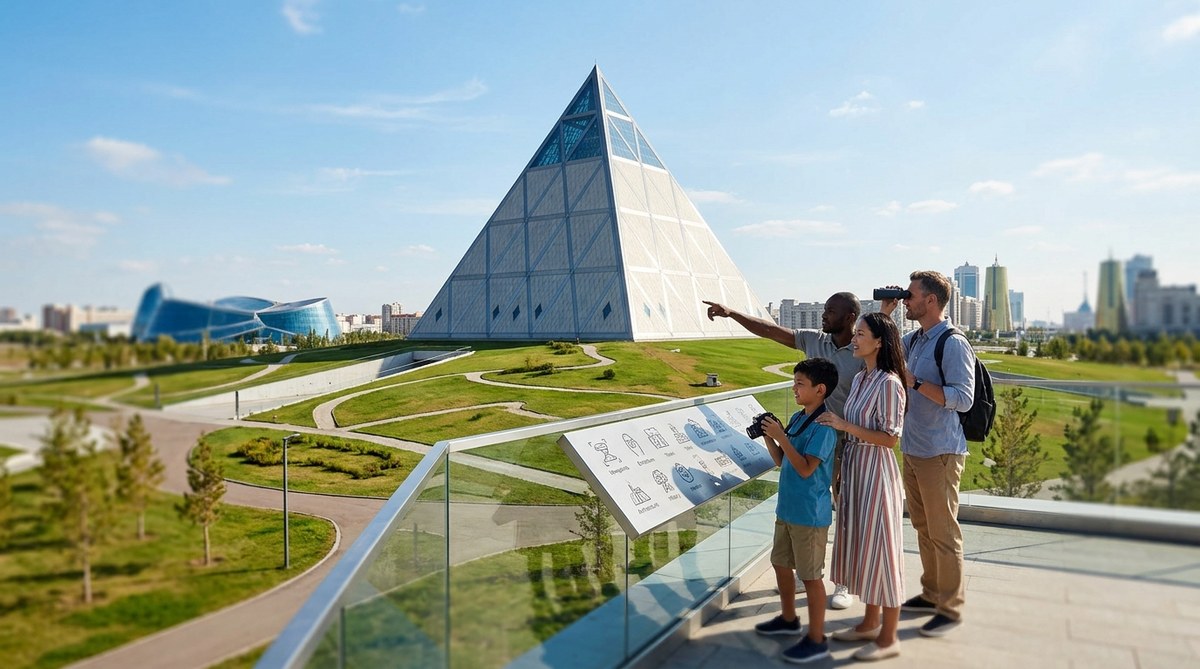
The pyramid rises from the flat Kazakh steppe like a vision from another century. At 62 meters tall, the Palace of Peace and Reconciliation Astana commands attention from every angle, its glass apex catching the endless sky. Designed by the legendary architect Norman Foster, this building isn’t just a landmark. It is a statement about what Kazakhstan wants to be: a bridge between cultures, a home for dialogue, and a place where the world’s religions can sit at the same table. I remember my first glimpse of it from across the Ishim River. My driver smiled and said, “That’s where we show the world we are one people.” He wasn’t wrong.
The Palace of Peace and Reconciliation in Astana is a 62-meter pyramid designed by Norman Foster. Built in 2006, it serves as a global center for religious dialogue and cultural events. Visitors can explore the Congress Hall, art galleries, and the breathtaking atrium. Allow 90 minutes for a self-guided tour. Book tickets online to skip queues. The nearby Left Bank district offers modern architecture and riverfront dining to complete your day.
Why This Pyramid Matters More Than You Think
Kazakhstan surprised the world when it moved its capital to Astana in 1997. The city grew fast, rising from a provincial town into a showcase of futuristic architecture. The Palace of Peace and Reconciliation became the spiritual heart of that transformation.
President Nursultan Nazarbayev wanted a venue for the Congress of Leaders of World and Traditional Religions. He asked Norman Foster to design something that had never been built before. The result was a pyramid based on the golden ratio, clad in pale granite and glass. It opened in 2006, and it has hosted world leaders, clergy, and artists ever since.
But here is the thing: you don’t need to attend a summit to feel the power of this place. The building is open to the public most days, and walking through its halls gives you a sense of Kazakhstan’s ambition. It says “we are modern, we are open, and we welcome everyone.”
What You Will See Inside the Palace
The entrance leads you into a soaring atrium. Light pours down from the apex, which is filled with stained glass by the British artist Brian Clarke. The glass panels show doves, representing peace, and they change color as the sun moves across the sky.
The Atrium and the Stained Glass Ceiling
Stand in the center of the atrium and look up. The glass panels form a kaleidoscope of blues, golds, and whites. On a sunny afternoon, the floor becomes a canvas of shifting colors. This is the single most photographed spot in the building, and for good reason.
The Congress Hall
The main auditorium seats 1,300 people. It is used for concerts, conferences, and the Congress of World Religions. The walls are lined with acoustic panels, and the stage is designed so that every seat has a clear view. If you get a chance to attend an event here, take it.
The Opera Hall and Art Spaces
A smaller hall hosts operas and chamber music. Above that, the upper floors contain exhibition spaces where you can see contemporary Kazakh art. The art rotates regularly, so check the schedule before you go. I saw a show of felt tapestries that told stories from the nomadic tradition. They were stunning.
The Observation Platform
The top floor offers a viewing area. From here you can see the meandering Ishim River, the towers of the Left Bank, and the endless steppe stretching to the horizon. It is a place to pause and appreciate how far this country has come.
How to Plan Your Visit: A Step by Step Guide
Let me walk you through the practical side. Here is a numbered process that will save you time and hassle.
-
Check the opening hours before you go. The Palace is usually open Tuesday through Sunday, from 10:00 AM to 6:00 PM. Mondays are often closed. Always confirm on the official website, because event days can change the schedule.
-
Buy your tickets online. You can purchase tickets at the door, but I recommend booking through the official site or a trusted tour platform. This guarantees your spot and saves you from standing in line.
-
Choose your tour type. You can wander the public areas on your own, or you can hire a guide. A guided tour takes about 60 minutes and goes into the history, the architecture, and the symbolism of the design. For most visitors, a self-guided visit is enough.
-
Arrive 15 minutes early. Security screening takes a few minutes, and you want time to admire the exterior before you step inside.
-
Respect the dress code. This is a place of interfaith dialogue. Shoulders and knees should be covered. You don’t need a suit, but a collared shirt and trousers are appropriate.
-
Finish at the gift shop. The small shop near the exit sells local crafts, books about Astana, and miniature pyramids. It is a good place to pick up a souvenir that actually means something.
What to Bring and What to Leave Behind
| Do Bring | Don’t Bring |
|---|---|
| A camera or phone for photos | Large backpacks or suitcases |
| A light jacket (the atrium can be cool) | Food or drinks |
| Your passport or ID (required for entry) | Tripods without a permit |
| Comfortable walking shoes | Drones or professional video gear |
| A notebook if you like sketching | Pets (service animals allowed) |
The security staff are friendly but thorough. If you arrive with a big bag, you will have to check it. Keep your valuables small and close.
When to Visit for the Best Experience
Timing makes a difference. Summer months (June through August) offer long daylight hours and warmer weather. The stained glass ceiling is at its most dramatic between 2:00 PM and 4:00 PM, when the afternoon sun illuminates the entire atrium.
Winter has its own appeal. Astana in January is cold, with temperatures sometimes dropping to -30 degrees Fahrenheit. But the pyramid is heated, and the contrast between the snowy landscape and the warm golden light inside is magical. Plus, the crowds are thinner.
If you want to see the Palace in action, plan your trip around the Congress of Leaders of World and Traditional Religions. This event usually happens every three years. The next one is expected in 2027, but always check the official calendar. During the congress, the building buzzes with energy, and you might see delegates from Buddhist, Christian, Hindu, Islamic, and Jewish traditions walking the halls together.
How to Combine the Palace With Other Astana Attractions
The Palace sits in the Left Bank district, which is the modern part of Astana. You can easily spend half a day here.
Start at the Palace of Peace and Reconciliation. Spend 90 minutes inside. Then walk south along the river to the Norman Foster-designed Khan Shatyr Entertainment Center. That transparent tent houses a shopping mall, a beach resort, and restaurants. It is surreal, and I mean that in the best way.
From there, cross the bridge to the right bank and visit the Bayterek Tower. The golden observation sphere offers a panoramic view of the entire city. If you want to avoid the crowds, check out our guide to visiting Bayterek Tower without the tourist crowds.
If you have more time, consider a walking tour of the Left Bank. We have a detailed route in The Ultimate Walking Tour of Astana’s Futuristic Left Bank District. It covers the Palace, the Kazakhstan Central Concert Hall, and the striking government buildings.
Photography Tips for the Pyramid
The Palace of Peace and Reconciliation is a photographer’s dream. Here are the settings I recommend.
- Wide angle lens. The atrium is tall and spacious. A 16-35mm lens (or your phone’s wide mode) will capture the full height.
- Shoot in the afternoon. The light through the stained glass is best between 2:00 PM and 4:00 PM.
- Use a polarizing filter. This reduces glare from the glass panels and deepens the blue tones.
- Shoot from the balcony. The upper levels offer a downward view that shows the geometric patterns of the floor.
- Keep your shutter speed above 1/100. The interior is bright, so you don’t need a tripod.
For more Astana photography advice, read our piece on how to photograph Astana’s golden towers like a professional.
A Quick Note on Tickets and Pricing
As of 2026, ticket prices are very reasonable. Adult entry costs around 1,500 KZT (about $3.20 USD). Students and children pay half price. Guided tours add about 2,000 KZT per person.
You can book through the official ticket platform. I always do this a day in advance. It takes two minutes and saves the hassle of dealing with cash or queues.
“The pyramid is not just a building. It is a symbol of our commitment to peace,” a guide told me as I stood in the atrium. “When you walk through these doors, you are part of that mission.”
Where to Stay Near the Palace
The Left Bank has most of Astana’s modern hotels. Staying here puts you within walking distance of the palace and other landmarks.
For a mid-range option, try the Rixos President Hotel. It is a 10-minute walk from the pyramid and offers solid service. If you prefer something more affordable, the ibis Astana is clean and reliable. Luxury travelers should look at the St. Regis Astana, which sits on the riverfront and has a spa.
For a curated list of design-friendly stays, see our guide to Astana’s best boutique hotels for design lovers.
How to Get to the Palace
The Palace of Peace and Reconciliation is located at 51 Tauelsizdik Avenue. It is about 15 minutes by car from the city center. You can take a taxi for around 500 KZT ($1 USD). Use the Yandex Go app, which is the local ride-hailing standard.
Public buses 10, 12, and 21 stop within a 5-minute walk. If you are arriving from the airport, the drive takes about 30 minutes. Check our guide on how to get from Astana airport to city center for all the options.
What to Eat Nearby
After your visit, you will be hungry. The Left Bank has plenty of good restaurants.
- Saksaul. A modern Kazakh restaurant serving beshbarmak (horse meat noodles) and manti dumplings. It is a 10-minute walk from the palace.
- Rumi. Excellent Uzbek and Middle Eastern food. The plov here is legendary.
- The Kitchen. A casual spot with salads, sandwiches, and strong coffee.
For a deeper look into the local food scene, check out 10 Kazakh dishes you must try before leaving Astana.
When Things Go Wrong: Common Issues and Fixes
| Problem | Solution |
|---|---|
| The palace is closed for a private event | Check the official calendar and reschedule. Most closures are announced a week in advance. |
| Your taxi driver doesn’t know the address | Show them the Russian name: Дворец Мира и Согласия (Dvorets Mira i Soglasiya). |
| You forget your passport | The security team requires ID. You will be turned away. Go back and get it. |
| The guided tour is fully booked | The self-guided route covers 90% of the same content. Save the tour for another day. |
| It is raining and you wanted outdoor photos | Use the covered walkways and focus on interior shots. The atrium looks great in cloudy light. |
A Final Thought on Visiting
The Palace of Peace and Reconciliation Astana is more than a photo opportunity. It is a place where you can feel the pulse of modern Kazakhstan. The building symbolizes a nation that chose dialogue over conflict, openness over isolation, and beauty over blandness. When you stand in that atrium, with the light streaming down through the doves, you will understand why Astana calls itself the city of peace.
Take your time. Talk to the staff. Let the space work on you. Then walk out into the bright streets of the Left Bank and join the river of people moving through this strange, wonderful city.
For more inspiration, read our guide on how to experience Astana’s future-forward attractions like a local. And if you are planning to stay longer, our budget breakdown for traveling Kazakhstan will help you plan your expenses.
Safe travels, and enjoy the pyramid.