
You have probably read about Kazakhstan’s futuristic trains or the endless steppe. But no one really prepares you for the specific quirks of the daily commute. Things like why locals stare at you on the bus, how to actually pay for a marshrutka, or why you should never sit on a certain part of the train. Here are the real Kazakhstan public transport tips that no one tells you.
The key to mastering Kazakhstan public transport is understanding its honor system. Buses require a prepaid card or QR code. Marshrutkas operate on trust and cash passing forward. Trains follow a strict social code: shoes off, share food, respect the lower bunk. Taxis are cheap only if you use the app. Locals pay 80 KZT for a bus and 1,500 KZT for a long taxi ride. Do not overpay.
The Bus System Runs on Trust and a Card
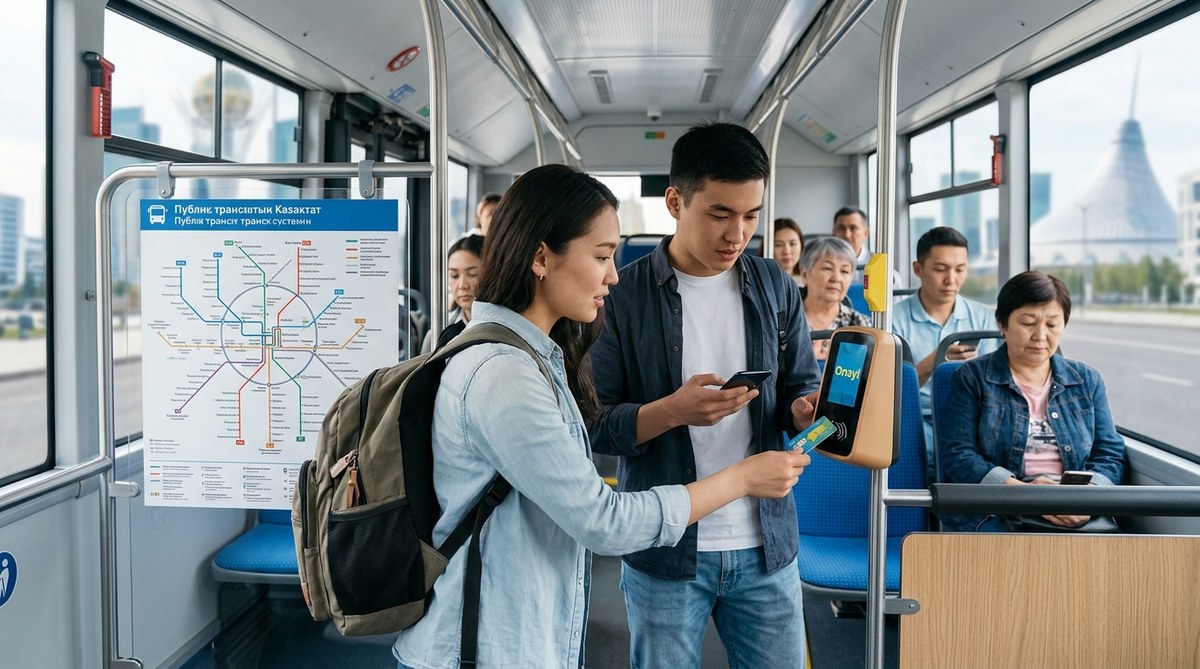
In Astana and Almaty, buying a ticket from the driver does not really exist. You need a transport card. Tourists show up with cash and get confused at the validator.
You tap the card for yourself. You do not tap for someone standing behind you. Each person taps individually. The system runs on an honor model. There is no gate. You just walk onto the bus. But inspectors do random checks. If you do not tap, the fine is steep.
The card is called Onay. You can buy it at any convenience store. Look for the blue kiosks or the small shops near bus stops. The card deposit costs 500 KZT. You load money onto it.
If you do not get a card, some buses accept credit cards at the front reader. The machine is often slow or broken. Just get the card. It will save you time and awkward stares.
| Feature | Astana (Onay) | Almaty (Onay) |
|---|---|---|
| Card Cost | 500 KZT deposit | 500 KZT deposit |
| Fare per ride | 100 KZT | 80 KZT |
| Payment methods | Card / QR code | Card / QR / Cash |
| App name | Onay! | Onay! |
The unspoken rule involves the doors. You enter through the front door and tap. You exit through the middle or back door. If you stand near the back door without moving to exit, locals will give you a look that says “move inside.” Do not block the flow.
Marshrutkas Are the Wild West (And That’s the Point)
Marshrutkas are minibuses. They are faster than regular buses but have no written rules. Every marshrutka feels like a test of your street smarts.
Here is the unwritten code of the marshrutka:
- Wave it down. Marshrutkas do not stop at every bus stop. They only stop if you flag them. Stick your hand out as they approach. Do this with confidence.
- Pass your cash forward. There is no conductor in a marshrutka. You hand your money (usually 100 KZT) to the person in front of you. They hand it to the driver. Change comes back the same way through the hands of strangers.
- Yell to stop. The stop button is often hidden, broken, or missing. You must yell “Astagite!” (STAH-gih-tyeh) to the driver. It means “Stop here, please.” Do not whisper. Locals will not help you if you are too quiet. You have to claim your stop.
- Squish in tight. Marshrutkas leave when full. If there is any standing room, you must take it. Personal space is not a concept here. You will sit with a bag on your lap and a stranger’s elbow in your shoulder.
- No bags on seats. A marshrutka seat is for a person. Your bag goes on your lap or the floor. If you put a bag on a seat, someone will give you a sharp look or simply move it themselves.
Your phone is your best tool here. Use 2GIS to check which marshrutka route to take. The numbers are usually painted on the windshield.
Trains Have a Strict Social Code
Long distance trains in Kazakhstan are a beautiful experience. They are comfortable, affordable, and feel like a trip back in time. But they have a specific social etiquette that tourists often break without knowing.
Train cabins (kupe) have four bunks. The lower bunks are the “king” seats. If you have a lower bunk, you own the small table for the journey. Upper bunk passengers are expected to ask permission to sit on the lower bunk during the day. It sounds formal, but it is just polite.
“A local once told me, ‘Never put your bags on the top bunk if someone is sleeping below. The top bunk is sacred storage space.’ I ignored this and got a very cold stare for the whole 18 hour journey. The unwritten rule is simple. Your suitcase goes under the lower bunk. Your day bag goes on the top bunk. Your shoes come off at the door. You share your food. And you never, ever complain about the heat.” – A frequent traveler on the Almaty to Astana route.
Some other tips for train travel. Bring slippers. The floor gets dirty fast. Bring your own snacks and tea. The dining car is average, but local travelers bring whole meals. Share what you have. It is the Kazakh way.
Your Phone Is the Only Ticket You Need
Kazakhstan is surprisingly digital. Your smartphone replaces cash and cards for most transport needs. Do not rely on paper maps or asking strangers.
- Download 2GIS. This app is more accurate than Google Maps for bus routes and live arrival times in Kazakhstan. It tells you exactly which marshrutka number to take and where to get off. Trust 2GIS over Google.
- Download Yandex Go. This is the main ride hailing app. Do not flag down taxis on the street. They will charge you three to five times the normal rate. The app shows the price upfront. You can pay cash or card. Always use the app.
- Use the Onay app. Instead of a physical card, you can use the Onay app to generate a QR code. Scan it at the bus validator. This is how many locals do it now. It saves you the trouble of finding a kiosk to top up a physical card.
- Keep a screenshot of your route. Mobile data is excellent in Kazakhstan, but have a backup. If your signal drops, you can still show the map to a driver or conductor.
Why Taxis Are Cheaper Than You Think (If You Use the App)
First time visitors often get ripped off. A taxi driver at the Astana Airport might ask for 5,000 KZT to the city center. The Yandex Go fare for the same trip is around 1,500 KZT. That is a huge difference.
The trick is to walk outside the terminal. Stand in the parking lot. Open the app. Order an Economy or Comfort ride. The app uses GPS so it knows exactly where you are. Do not approach the drivers waiting at the arrivals gate. They are hunting for tourists.
Pay by card in the app to avoid arguing about change. And do not tip taxi drivers. Rounding up to the nearest 500 KZT is fine, but tipping is not expected.
The same logic applies to rides within the city. A trip from the Left Bank to the Right Bank costs about 1,200 to 2,500 KZT. It is cheaper than a pizza. Use the app or you will overpay.
The Real Cost of Getting Around in 2026
Let me give you a clear picture of what you will spend. These are the current rates for 2026.
- Bus ride: 100 KZT (about $0.20).
- Marshrutka: 100 to 150 KZT (about $0.25).
- Yandex Go across Astana: 1,200 to 2,500 KZT (about $2.50 to $5.00).
- Train from Astana to Almaty (kupe class): 15,000 to 25,000 KZT (about $30 to $50).
- Flight from Astana to Almaty: 25,000 to 60,000 KZT (about $50 to $120).
For a country the size of Western Europe, these prices are a steal. The best value is the overnight train. It covers a 1,000 kilometer trip while you sleep. It also saves you a night of hotel costs.
If you are on a tight budget, stick to the buses and marshrutkas. If you want comfort, use Yandex Go for door to door service. If you want an adventure, take the train.
Plan Your Intercity Route Around the Train Schedule
Kazakhstan is huge. Flying across the country is common for business travelers. But the train is the real experience. It connects the major cities and the forgotten towns.
If you are going from Astana to Almaty, the overnight train is ideal. It leaves around 8 PM and arrives around 7 AM. You save a full day.
If you are heading to Turkestan or Shymkent, the train is slower but far more scenic. You pass through the steppe and small villages.
For comprehensive details on all your options, check the Getting Around Kazakhstan handbook. It covers buses, trains, flights, and car rentals.
And if you are staying in Astana’s futuristic Left Bank, you might enjoy the Ultimate Walking Tour of Astana’s Futuristic Left Bank District. It pairs well with public transport tips.
Master These Unwritten Rules and Travel Smarter
Kazakhstan’s public transport system is efficient, cheap, and full of character. The real hurdle is not the language. It is the unspoken social contract. Respect the queue. Keep your voice down on trains. Have your card ready before you board. Yell “Astagite” with confidence.
When you understand these Kazakhstan public transport tips, you stop being a confused tourist. You become a confident traveler. The city opens up. You stop fearing the marshrutka and start enjoying the freedom it gives you.
Go buy an Onay card. Download Yandex Go. Take that bus to the edge of the steppe. You are ready for it now.