
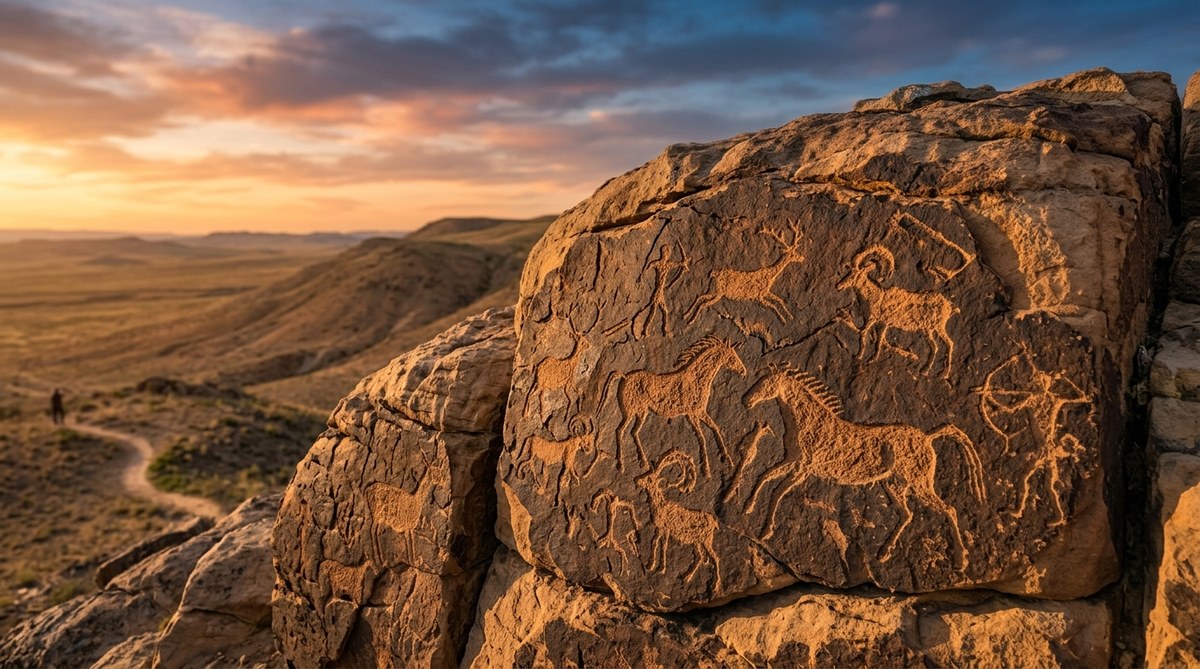
Kazakhstan holds one of the world’s greatest collections of ancient rock art, yet most travelers have never heard of it. Scattered across the steppe, tucked into river gorges, and hidden in mountain passes, thousands of petroglyphs tell stories that stretch back more than 4,000 years. These carvings show hunters chasing deer with bows, shamans performing rituals, and warriors riding horses into battle. They record the birth of nomadic culture on the Eurasian steppe. For anyone passionate about ancient history, these sites offer a direct connection to the people who shaped Central Asia long before the Silk Road existed.
Kazakhstan is home to some of the most significant ancient petroglyph sites in Central Asia, with carvings dating from the Bronze Age to the Turkic period. The most accessible and famous site is Tamgaly, a UNESCO World Heritage location near Almaty. Other major sites include Eshkiolmes in the Dzungarian Alatau, Arpa-Uzen in the Karatau Mountains, and remote galleries in the Altai region. Visiting these sites rewrites your understanding of how ancient nomadic societies lived, worshipped, and communicated.
Why Kazakhstan’s Rock Art Matters
The steppe of Kazakhstan was never an empty void. For thousands of years, it was home to pastoral tribes who left no cities behind. They built no stone temples and wrote no books. Instead, they carved their history into the rocks. These petroglyphs are the only written record we have of their world.
What makes the ancient petroglyph sites in Kazakhstan so special is their sheer scale and variety. You will find images of extinct animals like the aurochs and wild ass. You will see chariots that predate the Chinese dynasties. You will find sun-headed deities that mirror similar figures found thousands of miles away in Siberia and the Caucasus. This rock art connects the dots of human migration across the continent.
Tamgaly: The Crown Jewel of Kazakh Petroglyphs
Tamgaly is the most famous and best preserved of all ancient petroglyph sites in Kazakhstan. Located about 170 kilometers northwest of Almaty, this UNESCO World Heritage site contains over 5,000 individual carvings spread across a series of rocky gorges.
The name Tamgaly means “painted” or “marked place” in Kazakh. It is an apt description. The main canyon is lined with dark basalt boulders covered in images that span three major periods: the Bronze Age (around 1500 BCE), the early Iron Age (8th to 3rd centuries BCE), and the Turkic period (6th to 12th centuries CE).
What to look for at Tamgaly:
- The sun-headed gods. The most famous carvings show large figures with radiating rays around their heads. These are thought to represent a sun deity or a shaman in a trance state. They are the iconic image of Kazakh rock art.
- The chariot scenes. Bronze Age artists carved detailed two-wheeled chariots pulled by horses. These are some of the oldest depictions of wheeled transport in Central Asia.
- The hunting sequences. You will see archers on foot and on horseback pursuing deer, wild boar, and goats. The level of detail in the animal anatomy is remarkable.
Tamgaly is accessible as a day trip from Almaty. You can hire a car and driver for the journey, or join a guided tour. The site has a small museum and marked walking trails. Allow at least three hours to see the main galleries.
For a broader view of Kazakhstan’s ancient past, consider combining a visit to Tamgaly with a trip to the https://astana-kazakhstan.net/the-complete-guide-to-visiting-bayterek-tower-without-the-tourist-crowds/ in Astana, where the National Museum holds an excellent collection of petroglyph casts and Bronze Age artifacts.
Eshkiolmes: The Valley of the Ghosts
In the Dzungarian Alatau mountains of southeastern Kazakhstan lies Eshkiolmes, a site that feels truly remote. The name translates to “the ghost will not go away,” a reference to local legends about spirits that guard the valley. Over 10,000 petroglyphs have been documented here, making it one of the densest concentrations of rock art in the country.
Eshkiolmes dates primarily from the Bronze Age through the Saka period (early Iron Age). The carvings here are notable for their large size. Some animal figures measure over a meter in length. The site also features tamga symbols, the tribal marks used by ancient Turkic peoples to claim territory.
What makes Eshkiolmes special is its setting. The valley is surrounded by dramatic red cliffs and offers views of snow-capped peaks. The isolation means you will likely have the site to yourself. Getting there requires a 4×4 vehicle and a guide familiar with the area. It is best visited as part of a longer trip through the Dzungarian region.
Arpa-Uzen: The Karatau Masterpieces
Deep in the Karatau Mountains of southern Kazakhstan, the Arpa-Uzen site contains some of the most artistically sophisticated petroglyphs in the country. The carvings here are smaller and more intricate than those at Tamgaly. They show a culture that had mastered the art of composition.
The Bronze Age panels at Arpa-Uzen are particularly important. They depict complex ritual scenes with multiple figures arranged in narrative sequences. You can see processions of priests, scenes of animal sacrifice, and what appears to be a solar calendar. The artists used the natural contours of the rock to give their figures a three-dimensional quality.
Arpa-Uzen is harder to reach than Tamgaly. It lies near the town of Shymkent, about a four-hour drive from Almaty. The site is not developed for tourism. You will need a local guide and a sturdy vehicle. The reward is an intimate encounter with ancient art that few foreigners ever see.
The Altai Petroglyphs: Siberia’s Southern Frontier
The Altai Mountains in eastern Kazakhstan hold some of the most mysterious ancient petroglyph sites in the country. This region is culturally and geographically connected to the Russian Altai and western Mongolia. The rock art here shows strong influences from the Scythian world, with its famous “animal style” of curled predators and stylized deer.
Key sites in the Kazakh Altai include:
- Kurchum Valley. Hundreds of carvings spread along the banks of the Kurchum River. Look for images of snow leopards and argali sheep.
- Kalbak-Tash. A site near the Russian border with well-preserved Turkic period carvings, including inscriptions in the ancient Orkhon script.
- Berel. Famous for its frozen burial mounds, the area also contains petroglyphs that date to the Scythian period (5th to 3rd centuries BCE).
The Altai region is best reached from the city of Oskemen (Ust-Kamenogorsk). You can fly there from Astana or Almaty. From Oskemen, you will need to arrange a multi-day expedition with a tour operator. This is serious adventure travel, but the combination of petroglyphs, pristine wilderness, and nomadic culture is unmatched.
Sauyskandyk: The Ustyurt Plateau’s Hidden Gallery
On the Mangyshlak Peninsula near the Caspian Sea, the Sauyskandyk site offers something completely different. Here, the petroglyphs are carved into the soft limestone of the Ustyurt Plateau. The style is more abstract and geometric than the naturalistic animals found at other sites.
Sauyskandyk dates from the early medieval period (7th to 10th centuries CE). The carvings include intricate patterns, crosses, and symbols that may represent star maps or tribal boundaries. The site is located near the famous Shakpak-Ata underground mosque, making it a good addition to a tour of the Mangystau region.
The Ustyurt landscape is otherworldly. White rock formations rise from a flat desert plain. The silence is absolute. Visiting Sauyskandyk requires a guide and a vehicle capable of handling rough desert tracks. The nearest city is Aktau, which has flights from Astana and Almaty.
How to Plan Your Petroglyph Trip
Visiting the ancient petroglyph sites in Kazakhstan requires some planning. Here is a practical process for organizing your trip.
- Choose your base. Almaty is the best starting point for Tamgaly and the southern sites. Astana works for trips to the central steppe. Oskemen is the gateway to the Altai. Aktau serves the Mangystau region.
- Hire a guide. Many sites are not signposted in English. A local archaeologist or experienced tour guide will show you carvings you would miss on your own.
- Bring the right gear. You will need sturdy walking shoes, sun protection, plenty of water, and a camera with a zoom lens for photographing high-up carvings.
- Respect the sites. Do not touch the petroglyphs. Do not rub them to make them clearer. This damages the patina and accelerates erosion.
- Time your visit. Spring (April to June) and autumn (September to October) offer the best weather. Summer heat can be intense, especially in the southern deserts.
For travelers who want to see a wider range of Kazakhstan’s cultural heritage, the https://astana-kazakhstan.net/the-silk-road-in-kazakhstan-5-ancient-cities-you-must-explore/ provides a perfect complement to the petroglyph sites, showing how later civilizations built upon the foundations of these ancient cultures.
What to Bring to a Petroglyph Site
| Item | Why You Need It |
|---|---|
| Wide-brimmed hat | The steppe sun is intense. No shade exists at most sites. |
| 2 liters of water minimum | Sites are remote. There are no shops or cafes. |
| Camera with 200mm+ lens | Many carvings are high on cliff faces. A zoom lens captures details. |
| Field notebook | Sketching the carvings helps you remember the layout and context. |
| GPS or offline maps | Cell service is unreliable. Download maps before you go. |
| Sunscreen (SPF 50+) | Reflection off the rocks can burn exposed skin quickly. |
What the Carvings Tell Us
The ancient petroglyph sites in Kazakhstan are not random graffiti. They are deliberate records of belief systems, economic activities, and social structures. Here are the main themes you will encounter.
- Hunting and animals. The most common subject. These carvings show what people ate and how they hunted. They also reveal which animals were sacred or dangerous.
- Ritual and religion. Sun-headed figures, dancing humans, and ceremonial scenes suggest a complex spiritual life. Some sites may have been used as open-air temples.
- Warfare and status. Scenes of armed warriors and chariot processions indicate social hierarchy and conflict. The chariot images are particularly important because they show contact with distant cultures.
- Symbols and tamgas. Abstract marks and geometric patterns are tribal identifiers. They prove that different groups used the same sites over centuries.
“The petroglyphs of Kazakhstan are the autobiography of the steppe. They tell us what people valued, what they feared, and what they hoped for. No written text from this period exists, so these stones are our only window into their minds.” Dr. Aigul Zhunisova, Kazakh Institute of Archaeology.
Seeing Petroglyphs from Astana
If you are based in Astana and want to see ancient rock art, you have options. While no major petroglyph site lies within the city limits, there are several accessible day trips and longer excursions.
The https://astana-kazakhstan.net/7-breathtaking-day-trips-from-astana-you-can-t-miss/ includes the Burabay National Park, where smaller petroglyph panels can be found near the lakes. These are not as extensive as Tamgaly, but they offer a taste of ancient rock art in a beautiful setting.
For a deeper experience, you can fly from Astana to Karaganda and drive south to the Karkaraly Mountains. This area has several undocumented petroglyph sites that local guides can show you. The landscape of granite outcrops and pine forests is unlike the southern deserts.
The Future of Kazakhstan’s Rock Art
Preservation is a growing concern. Weathering, vandalism, and unregulated tourism threaten many sites. UNESCO designation has helped protect Tamgaly, but other locations lack legal protection. In 2026, new initiatives are underway to train local communities as site guardians and to develop sustainable tourism models.
As a visitor, you can help. Report any damage you see to park authorities. Do not take rubbings or casts. Stay on marked paths. And share your photos and stories responsibly, so others can appreciate these treasures without harming them.
Why These Stones Still Speak
The ancient petroglyph sites in Kazakhstan are not just archaeological curiosities. They are a direct link to the people who first domesticated the horse, who built the earliest chariots, and who created the nomadic way of life that defined Central Asia for millennia. Standing in front of a 4,000-year-old carving of a deer, you feel the weight of time. The artist who made that image lived in a world without metal tools, without writing, without cities. Yet they created something that still communicates across the ages.
That is the power of these sites. They rewrite your understanding of history. They show that the steppe was never empty. It was always full of people living, hunting, praying, and leaving their mark on the world.
Plan your visit to at least one of these sites. Start with Tamgaly if you are short on time. Venture to Eshkiolmes or Arpa-Uzen if you want solitude. And if you have the spirit for real adventure, head to the Altai. The rocks are waiting, and they have stories to tell.