
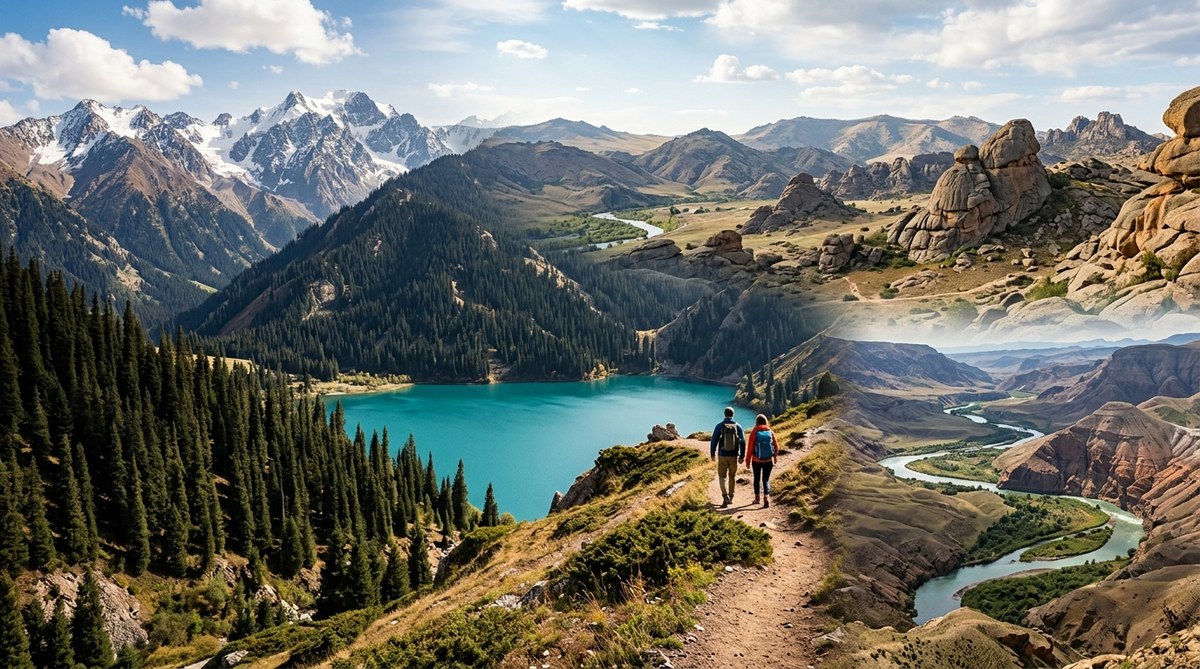
Kazakhstan is the ninth-largest country in the world, yet most visitors only see two parks: Charyn Canyon and the Big Almaty Lake area. That is a shame. Hidden across this vast nation are national parks that rival anything in the Rockies or the Alps, and they sit nearly empty. You can hike for hours without seeing another tourist. You can spot wildlife that has learned to ignore people. And you can do it all without a reservation battle or a crowded trailhead. These are the underrated national parks in Kazakhstan that deserve a spot on your 2026 itinerary.
Kazakhstan holds some of Central Asia’s most spectacular wilderness areas that most travelers never see. From the Altai mountains to the Caspian steppe, five underrated national parks offer solitude, rare wildlife, and landscapes that feel untouched. This guide shows you how to visit them with confidence.
Why These Parks Stay Under the Radar
International tourists to Kazakhstan tend to cluster around Almaty and a handful of famous sites. The country’s tourism board has done a great job promoting Charyn Canyon and the Kolsai Lakes, but the deeper wilderness remains a secret even to seasoned Central Asia travelers. Part of the reason is logistics. Some parks require a 4×4 and a local guide. Others sit hours from the nearest city. But for the adventure traveler who craves empty trails, that inconvenience is exactly the point.
A second reason is timing. Many western travelers visit Kazakhstan on a stopover or a short visa run. They have three or four days, so they stick to what is easy. If you can give yourself a week or more, you can reach parks that feel like they belong to another era.
Let me show you five parks that changed how I see this country.
1. Katon-Karagay National Park: The Altai Wilderness
This is the largest national park in Kazakhstan, and it gets almost no international visitors. Katon-Karagay sits in the far eastern corner of the country, where the Altai mountains rise into Siberia. You will find glaciers, alpine meadows, and the headwaters of the Bukhtarma River. Snow leopards still roam these slopes, though you will need luck and patience to spot one.
The park has a network of hiking trails that range from easy day walks to multi-day treks. One of the best routes leads to the Rachmanovskie Klyuchi hot springs, where you can soak in mineral water while looking at snow-capped peaks. The water stays warm even in winter, and the pools are free to use.
Wildlife here includes moose, lynx, golden eagles, and the occasional bear. If you visit in late spring, the wildflowers turn the valleys into a carpet of purple and yellow. The local Kazakh families in nearby villages rent yurts to travelers, so you can sleep in a traditional felt home and eat homemade kurt (dried cheese curds) around a fire.
Getting to Katon-Karagay takes effort. You fly to Oskemen (Ust-Kamenogorsk), then drive five hours east. The road is paved for most of the way, but the last stretch requires a sturdy vehicle. Once you arrive, you will understand why the effort is worth it.
2. Burabay National Park: The Lake District Near Astana
Most travelers fly into Astana and head straight to the futuristic towers and shopping centers. But just three hours north lies a landscape that feels like a mini Finland. Burabay National Park is a mosaic of pine forests, granite outcrops, and clear blue lakes. The locals call it the “Kazakh Switzerland,” and for good reason.
Burabay is famous among domestic tourists, especially in summer, but very few international visitors make the trip. That means the trails are quiet on weekdays, and you can rent a rowboat on Lake Borovoe without waiting in line. The park has over 30 lakes, and each one has a different color depending on the mineral content.
The most iconic landmark is the Zhumbaktas rock formation, which looks like a giant stone head rising from the water. Legend says it is a petrified suitor who waited too long for his love. You can hike around the entire lake in about two hours, or you can take a longer route through the pine forest to the summit of Mount Kokshe, which offers panoramic views over the entire park.
Burabay is one of the easiest underrated national parks in Kazakhstan to reach. You can take a bus from Astana’s Saryarka bus station to the town of Shchuchinsk, then hop a local taxi to the park entrance. If you prefer comfort, many hotels in Astana offer day tours that include lunch and a guide. For a deeper experience, spend the night at the Rixos Borovoe resort or at a smaller guesthouse near the lake.
If you are based in the capital, this park makes a perfect weekend escape. Check out our Weekend in Burabay: Your Complete Guide to Kazakhstan’s Lake District for a full itinerary.
3. Korgalzhyn Nature Reserve: Where Flamingos Nest in the Steppe
This might be the most surprising entry on the list. Korgalzhyn Nature Reserve is a UNESCO World Heritage site that protects the Tengiz-Korgalzhyn lake system, one of the most important wetlands in Central Asia. It is also the northernmost nesting site for flamingos in the world.
Yes, flamingos. In Kazakhstan.
The reserve sits about 130 kilometers southwest of Astana, on the flat steppe that stretches toward the Caspian Sea. It feels like the edge of the earth. The lakes are shallow and salty, and the wind never stops blowing. In summer, the water turns pink with thousands of flamingos that come here to breed. You also see pelicans, cranes, and over 300 other bird species.
You can only visit Korgalzhyn with a guide, and you need a permit from the reserve office. This is not a place for independent wandering. The terrain is deceptive, and the salt flats can swallow a vehicle if you drive off the marked tracks. But the experience is unforgettable. You stand in the middle of the steppe with birds circling overhead and nothing but horizon in every direction.
The best time to visit is May through August, when the birds are most active. Early morning and late evening offer the best light for photography and the highest chance of seeing flamingos feeding along the shoreline.
4. Aksu-Zhabagly Nature Reserve: Central Asia’s Oldest Reserve
Established in 1926, Aksu-Zhabagly is the oldest nature reserve in Central Asia. It sits in the Talas Alatau mountains of southern Kazakhstan, near the border with Kyrgyzstan and Uzbekistan. The landscape is a dramatic mix of red sandstone canyons, rushing rivers, and alpine meadows.
The reserve is famous for its biodiversity. Kazakhstan is the original home of many tulip species, and Aksu-Zhabagly has some of the most beautiful wild tulips in the world. If you visit in April or May, the hillsides explode with red, yellow, and orange flowers. Later in the year, you can see ibex, argali sheep, and the elusive snow leopard.
The Aksu River canyon is the centerpiece of the reserve. It is a 150-meter-deep gorge that cuts through the red rock like a knife wound in the earth. You can hike along the rim or, with a guide, descend into the canyon itself. The trail to the Kyzylzhar waterfall is one of the best day hikes I have ever done. It takes about four hours round trip and passes through two different climate zones.
You need a permit to enter Aksu-Zhabagly, and you must be accompanied by a ranger for most routes. This is not a hassle; it adds to the experience. The rangers are knowledgeable and proud of their reserve. Many speak basic English and will point out plants and animals you would otherwise miss.
The nearest town is Shymkent, which is about two hours away. You can base yourself there and drive to the reserve for the day. Our guide on Is Shymkent Worth Visiting? A Traveler’s Honest Review offers practical advice on using the city as a launchpad.
5. Altyn Emel National Park: Singing Dunes and Ancient Burial Mounds
Altyn Emel is not completely unknown. The Singing Dune attracts a steady stream of visitors, and the park has appeared in several travel documentaries. But the vast majority of people come for the dune and leave. They miss the rest of the park, which is enormous and spectacular.
Altyn Emel covers over 4,600 square kilometers of desert, steppe, and mountain. It is home to the Aktau and Katutau mountain ranges, which look like something from another planet. The hills are striped in pastel shades of pink, green, and gray, and the erosion has carved them into shapes that resemble ruined castles.
The park also protects the last population of kulans (wild Asiatic asses) in Kazakhstan. These animals were nearly extinct, but a successful breeding program has brought them back. You can see herds of kulans grazing on the plain, often in the early morning. The park also has goitered gazelles, foxes, and eagles.
The Singing Dune itself is worth the trip. When the wind blows just right, the sand produces a low hum that sounds like a cello. Scientists still debate the exact mechanism, but the effect is mesmerizing. You can climb the dune and slide down, and the sand will sing beneath you.
To visit Altyn Emel, you need a 4×4 and a guide. The park is huge, and there are no marked trails for most of it. You should plan at least two days to see the main sights. There is a basic guesthouse near the entrance, or you can camp with permission.
Practical Steps to Plan Your Trip
Visiting these underrated national parks in Kazakhstan requires some advance work. Here is a simple process that works for all five parks.
-
Check visa requirements first. Most nationalities get visa-free entry for up to 30 days, but confirm your status on the official government portal. Our Kazakhstan Visa Guide: Everything You Need to Know Before You Go covers the latest rules.
-
Book your guide through a reputable agency. Parks like Korgalzhyn and Aksu-Zhabagly require official accompaniment. Agencies in Almaty and Astana can arrange this for you. Do not try to skip the permit process; it protects both you and the park.
-
Arrange transportation in advance. Renting a car is possible, but a driver who knows the roads is better. Many parks have unmarked dirt tracks that GPS does not recognize. Local drivers also know where the wildlife gathers.
-
Pack for variable weather. The steppe can be hot during the day and cold at night, even in summer. Bring layers, a windbreaker, sturdy boots, and sun protection. More details in our What to Pack for Kazakhstan: Season-by-Season Essentials Checklist.
-
Carry enough cash. Most park offices and local guesthouses do not accept cards. ATMs exist in major cities but can be unreliable in rural areas. Take out cash in Astana or Almaty before you head into the wilderness.
Park Comparison Table
| Park Name | Best For | Best Time to Visit | Difficulty | Key Wildlife |
|---|---|---|---|---|
| Katon-Karagay | Multi-day treks, hot springs | June to September | Moderate to hard | Snow leopard, moose, bear |
| Burabay | Day hikes, lake activities | May to October | Easy to moderate | Fox, deer, eagle |
| Korgalzhyn | Birdwatching, steppe landscapes | May to August | Easy (guided only) | Flamingo, pelican, crane |
| Aksu-Zhabagly | Canyon hikes, wildflowers | April to June | Moderate | Snow leopard, ibex, argali |
| Altyn Emel | Desert landscapes, wildlife viewing | April to October | Moderate | Kulan, gazelle, fox |
What to Bring (And What to Leave Behind)
Packing for these parks is different from packing for a trip to Europe or Southeast Asia. The conditions vary widely, and you cannot buy gear once you leave the cities.
- Binoculars are essential for Korgalzhyn and Altyn Emel, where wildlife is often far away.
- A good water filter or purification tablets. Stream water in the mountains is clean, but it is safer to filter it.
- A physical map. Cell service vanishes once you leave the main roads. Download offline maps too, but carry a paper backup.
- Cash in small denominations. Park entry fees are usually a few dollars, and rangers rarely have change.
- A headlamp with fresh batteries. Many guesthouses use generators that shut off at night.
- Sunscreen and lip balm with high SPF. The sun at altitude is brutal, even on cloudy days.
Leave behind expensive hiking gear that you would hate to lose. The dust and rough conditions will wear out equipment faster than you expect. Bring sturdy, mid-range gear that you are comfortable replacing.
“I have guided in Alaska, Patagonia, and the Himalayas. Kazakhstan’s national parks have the same raw beauty, but with a fraction of the visitors. The Aksu canyon alone is worth the flight. And the silence… you cannot find silence like that in most of the world anymore.”
Damir K., senior guide at Nomad Travel Kazakhstan
Making These Parks Part of Your Kazakhstan Itinerary
You do not need to choose between the famous sights and these hidden parks. They can complement each other. Start in Astana and spend a day seeing the landmarks like Bayterek Tower and the Palace of Peace and Reconciliation. Then drive to Burabay for a weekend. Fly to Shymkent and visit Aksu-Zhabagly on your way to Turkestan. Finish in Almaty and take a trip to Altyn Emel.
Each of these underrated national parks in Kazakhstan adds a different layer to your understanding of the country. The parks show you the land before the glass towers and the high-speed trains. They show you the Kazakhstan that nomads have known for centuries.
The infrastructure is improving every year. New roads, better guesthouses, and more English-speaking guides make these places more accessible than ever. But the crowds have not arrived yet. If you go in 2026, you will still have the trails mostly to yourself.
That window will not stay open forever. Kazakhstan is gaining attention as a travel destination, and these parks will eventually get the recognition they deserve. Go now, while the only sound on the trail is your own footsteps and the wind across the steppe.