
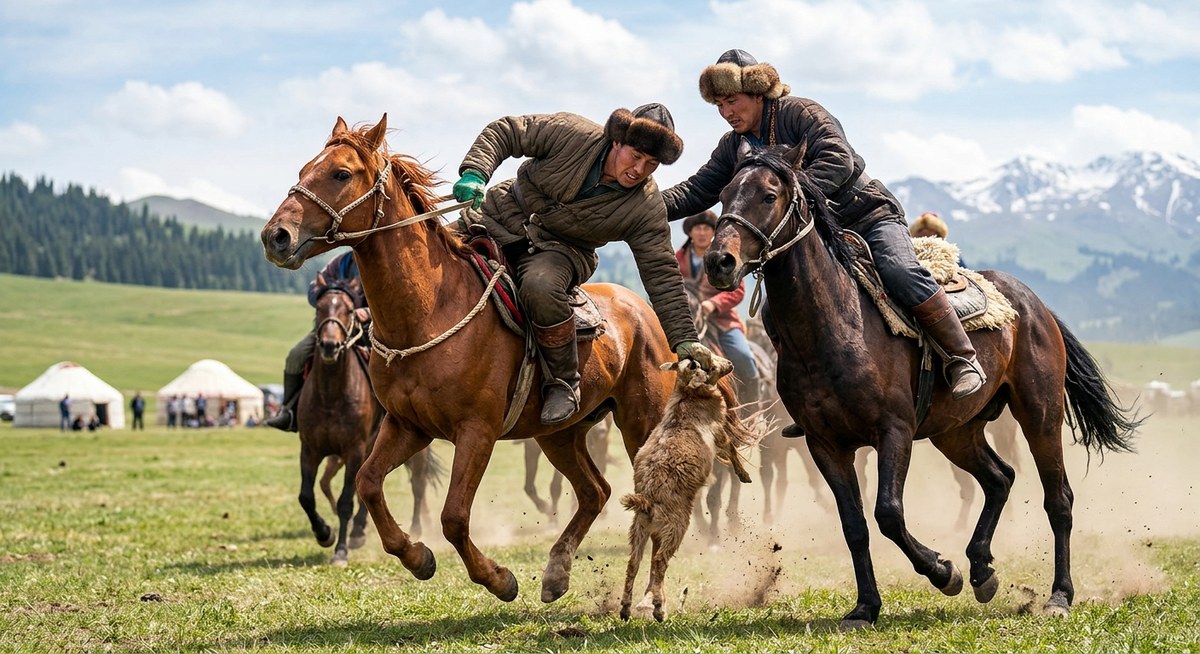
You hear the thunder of hooves before you see the riders. Dust rises in a golden cloud across the Kazakh steppe. A group of horsemen, bent low over their mounts, fight for control of a headless goat carcass. It looks like chaos. It feels like history coming alive. This is Kokpar, the Kazakh traditional horse game that has been played for centuries on the vast plains of Central Asia. For anyone fascinated by authentic cultural experiences, watching a Kokpar match is as raw and powerful as it gets. It is not a tourist show. It is a living, breathing tradition that reveals the soul of Kazakhstan.
Kokpar is Kazakhstan’s traditional horse game, often described as “polo with a goat carcass.” Two teams of horsemen fight to grab a headless goat carcass and carry it into the opponent’s goal. The sport dates back to Genghis Khan’s era and celebrates horsemanship and bravery. It is featured at the World Nomad Games and local festivals year-round. Travelers can watch matches in Astana, Almaty, or the countryside to see raw Kazakh culture up close.
What Is Kokpar? The Traditional Horse Game That Defines Courage
Kokpar (also spelled kökpar or kok-boru) is a traditional team sport played on horseback. The objective is straightforward: grab a headless goat carcass (or a heavy dummy in modern tournaments) and drop it into the opponent’s goal circle. But the simplicity ends there. This is a game of strength, speed, and strategy played at full gallop by riders known as kokparshy.
The name Kokpar comes from two Kazakh words: “kok” meaning blue or gray, and “par” meaning a large piece of meat. Some historians believe the name references the gray color of the animal carcass after the dust settles.
Kokpar is not just a sport. It is a school for horsemanship. Boys learn to ride by playing Kokpar. Families gather around the field to cheer. It is a celebration of the bond between rider and horse that has defined nomadic life in Kazakhstan for over a thousand years.
The Ancient Roots of the Game
Most sources trace Kokpar back to the time of the Mongol Empire. Warriors needed a way to practice battle tactics and stay sharp between campaigns. Fighting over a carcass mimicked the chaos of combat. It taught riders how to turn sharply, lean from the saddle, and grab a moving target while controlling a horse with only their legs.
By the 19th century, Russian explorers noted Kokpar as a central part of Kazakh identity. The Soviet era suppressed many traditions, but Kokpar survived in rural areas. When Kazakhstan became independent in 1991, the game experienced a strong revival.
Today, Kokpar is officially recognized as a national sport of Kazakhstan. It is a featured event at the World Nomad Games, which draw competitors from all over Central Asia. In 2026, the games continue to showcase Kokpar as one of the most exciting spectacles of nomadic heritage.
How Kokpar Is Played (Step by Step)
If you attend a Kokpar match, here is what you will see happen in sequence.
- The toss – A referee throws the carcass into the center of the field. Two riders, one from each team, race to be the first to grab it.
- The scrum – Players crowd around the carcass, wrestling to gain possession. Riders use their legs and free hands to fend off opponents while their horses bite and shoulder each other.
- The breakout – When a rider snatches the carcass, he spurs his horse toward the opponent’s goal. The chase is intense. Opponents try to block him, grab the carcass, or knock it loose.
- The pass or carry – Riders can pass the carcass to a teammate or carry it solo. Passing requires incredible coordination because the carcass is heavy (25–35 pounds).
- The score – The rider must drop the carcass into a circular goal area (the kazan), usually about 2.5 meters in diameter. A goal earns one point.
- The restart – After a goal, the game restarts from center. Matches last two halves of 20 minutes each.
The action never stops. Spectators rarely sit still.
Rules and Scoring: A Handy Table
Kokpar rules vary slightly between regions and tournaments, but the modern regulations used at the World Nomad Games are standard. Here is a breakdown of common rules and common mistakes new spectators might see.
| Rule Aspect | Official Rule | Common Mistake by Riders |
|---|---|---|
| Game duration | Two 20-minute halves with a 10-minute break | Playing too aggressively in the final minutes leads to dangerous tackles |
| Goal line | Carcass must drop into the round goal area (kazan) | Riders sometimes miss the circle because they lean too far forward |
| Penalties | Dangerous riding (kicking, hitting another rider’s horse) results in a 2-minute suspension | Grabbing the opponent’s reins is a frequent infraction |
| Horse rules | A rider can switch horses during breaks, but not mid-play | Using a horse that is not conditioned for the full match is a common error in local matches |
“Kokpar is not a brutal game like some outsiders think,” says local trainer Askar Niyazov, who has played for 30 years. “The skill is in using your horse’s momentum. A good rider wins with timing, not force. Watch how the horse angles its body. That is the real art.”
Why You Should See Kokpar Live
Kokpar is not something you understand from a video. You need to feel the ground shake and hear the shouting. Here are reasons to put it on your itinerary.
- It is a window into Kazakh identity – Kokpar connects modern Kazakhstan to its nomadic roots. It is played with the same spirit as a thousand years ago.
- The athleticism is mind blowing – Riders perform moves that would be impossible in a gym. They hang off the side of the horse, grab the carcass, and vault back into the saddle while galloping.
- The horses are stars – Kazakh horses are small, sturdy, and incredibly agile. They are bred for endurance and responsiveness.
- It is still a community event – Unlike many traditional sports, Kokpar is not a relic. It is played in villages on weekends. You can watch free matches in the countryside, far from tourist crowds.
- It pairs perfectly with other traditions – Kokpar festivals often include eagle hunting demonstrations, yurt exhibitions, and music. If you are planning a trip to Kazakhstan, you can combine Kokpar with other cultural activities.
Where to Watch Kokpar in Kazakhstan
The best time to see Kokpar is during the World Nomad Games, which take place every two years. In 2026, the games are scheduled for August in Astana. Tickets are affordable and the atmosphere is electric.
If you miss the games, you still have options.
- Astana – The capital hosts regular Kokpar tournaments at the Kokpar Arena and during national holidays like Nauryz. Check local listings.
- Almaty – The southern hub holds matches at the Almaty Hippodrome. Spring and fall weekends are the peak season.
- Rural areas – Travel to villages in the Almaty or Turkistan regions. Ask your host or guide about upcoming matches. These are less polished but more authentic.
Combine a Kokpar visit with other attractions. You can take a weekend in Burabay for a nature break, or see a match after a day of exploring Astana after dark.
Tips for First-Time Spectators
Attending a Kokpar match is different from going to a soccer game. Here is how to prepare.
- Sit on the side closest to the goal – You get the best view of the dramatic finishes.
- Bring a scarf – Dust flies. Cover your mouth and nose.
- Wear shoes you do not mind getting dusty – The field is dirt or grass. Spectators often stand near the edge.
- Respect the horses – Do not make sudden movements or loud noises near them.
- Learn a few Kazakh words – A shout of “Aya!” (go) or “Baqyt!” (luck) will earn smiles from locals.
- Do not bring small children – The game is fast and intense. Young kids may get scared by the noise and crowding.
How Kokpar Connects to the Broader Kazakh Culture
Kokpar is one piece of a larger cultural landscape. The Kazakh people have always been tied to the horse. The horse provided transport, food, and clothing. It was the center of life. Kokpar honors that relationship.
The game also reflects values like resilience, teamwork, and respect for elders. Before a match, older players bless the riders. Afterward, the winning team shares a feast called a dastarkhan, where they serve beshbarmak (boiled meat and noodles) and kumis (fermented mare’s milk).
If you want to understand Kazakh hospitality, you must see it in action after a Kokpar match. Strangers are invited to eat. Toasts are made. Stories are told. It is the kind of experience you cannot book online.
Kokpar Awaits: Plan Your Trip
Kokpar is not a tame attraction. It is loud, dusty, and emotional. That is exactly why you should see it. This traditional horse game shows you the side of Kazakhstan that guidebooks cannot capture.
Whether you watch the World Nomad Games in 2026 or a village match on a random Saturday, Kokpar will change how you think about Central Asia. It is a living tradition that refuses to fade.
So start planning. Check the event calendar, book your accommodation in Astana, and get ready for a sport that has been thrilling crowds since the time of the Silk Road. Your seat on the steppe is waiting.