
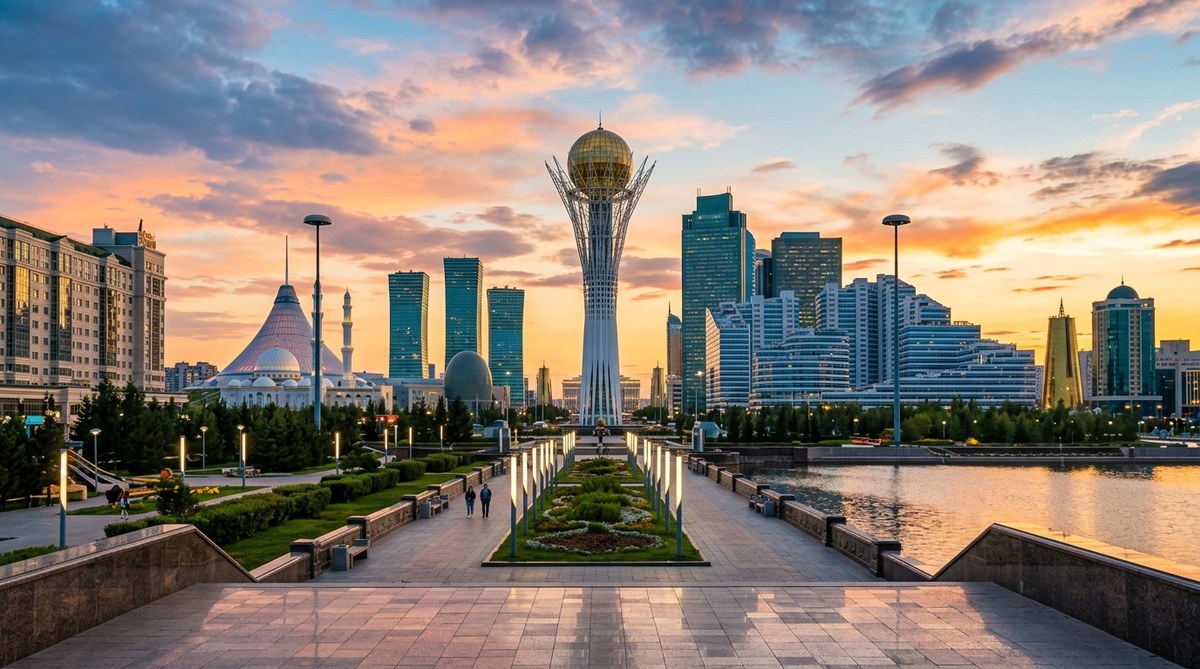
Astana rises from the flat Kazakh steppe like a mirage made of glass, steel, and ambition. One moment you are driving through endless grassland. The next, you see a golden tower shaped like a mythical tree, a giant glass tent, and a pyramid that glows blue at night. This city was not built slowly over centuries. It was designed and constructed in just over two decades. For anyone interested in modern architecture, Astana offers a case study unlike any other in the world. It is a blank canvas where architects from Japan, the UK, and Italy were given freedom to create without historical constraints. The result is a skyline that tells the story of a young nation looking forward.
Astana’s architecture is a unique blend of futuristic design and deep Kazakh symbolism. The skyline uses bold shapes like the Bayterek Tower, the Khan Shatyr tent, and the Nur Alem sphere to represent national identity. This guide explains the vision behind each landmark, how to see them in one day, and why this city is a must-visit for architecture fans in 2026.
The Vision Behind the City of the Future
In 1997, Kazakhstan moved its capital from Almaty to Astana. The decision was strategic. The city sits in the center of the country, far from the earthquake-prone mountains of the south. But it was also a symbolic act. Astana would become a showcase for modern Kazakhstan.
President Nursultan Nazarbayev invited world famous architects to compete for projects. The Japanese architect Kisho Kurokawa designed the master plan. His idea was to create a city that respected Eurasian unity. The buildings would not copy Western styles. Instead, they would use modern forms to express Kazakh culture.
This is why Astana’s architecture feels different from Dubai or Shanghai. It is not just about looking futuristic. Every major building carries meaning. The Bayterek Tower represents a tree of life from Kazakh mythology. The Palace of Peace and Reconciliation is a pyramid that symbolizes the unity of world religions. The Khan Shatyr giant tent recreates a nomadic shelter on an impossible scale.
For a deeper look at how these landmarks fit together, check out the walking tour of Astana’s futuristic Left Bank district.
The Landmarks That Define the Skyline
You cannot understand Astana architecture modern without standing in front of its key buildings. Each one represents a different architectural style and a different ambition.
Bayterek Tower: The Golden Tree
Bayterek is the symbol of Astana. It stands 97 meters tall, a number chosen because 1997 was the year the capital moved. The tower is a white stem topped with a golden sphere. Inside the sphere, you can place your hand in a golden cast of the president’s handprint. From the observation deck, you see the entire city laid out like a model.
The design comes from Kazakh legend. A magical bird lays a golden egg in a tree each year. The egg represents the sun and life. The tower turns this ancient story into modern sculpture.
Khan Shatyr Entertainment Center
This is the world’s largest tent structure. It is a translucent membrane held up by a central mast and cables. Inside, you find a shopping mall, a beach resort with sand imported from the Maldives, and indoor canals. The architect was Norman Foster, the same British architect who designed London’s Gherkin.
The tent shape is a direct reference to the yurt, the portable home used by Kazakh nomads for centuries. Foster took a traditional form and scaled it up to cover 127,000 square meters. The material lets in sunlight during the freezing winter months, keeping the interior warm without excessive energy use.
Nur Alem Sphere
This giant glass sphere is the centerpiece of the EXPO 2017 grounds. It is currently the largest spherical building in the world. The sphere houses a museum about future energy. The building itself uses solar panels and wind power.
The design is simple but powerful. A sphere has no beginning and no end. It represents the planet Earth and the idea of sustainable energy for all. At night, the glass facade lights up with patterns that change color.
For a more detailed look at this building, read our review of what makes the Nur Alem sphere the most unique building in Central Asia.
Palace of Peace and Reconciliation
This pyramid was also designed by Norman Foster. It stands 62 meters tall and uses a triangular glass apex that contains a stained glass artwork by the British artist Brian Clarke. The building hosts the Congress of Leaders of World and Traditional Religions.
The pyramid shape is universal. It appears in ancient Egypt, Mesoamerica, and modern architecture. Foster used it here to suggest stability and spiritual ascent. The building has no internal columns. The structure supports itself through its triangular geometry.
Astana Grand Mosque
Completed in 2022, this mosque is one of the largest in Central Asia. It can hold 30,000 worshippers. The main dome is 83.2 meters tall, making it one of the tallest in the world. The design combines traditional Islamic geometry with modern materials.
The four minarets are 130 meters high. The courtyard uses white marble from China. Inside, the chandeliers are made of Swarovski crystals. It is a building that balances religious tradition with contemporary scale.
If you are planning a visit, see our guide on why the Astana Grand Mosque deserves a spot on your attractions list.
How Astana Architecture Modern Compares to Other Global Cities
Many people compare Astana to Dubai. Both cities built futuristic skylines in a short time. But there are important differences.
| Feature | Astana | Dubai |
|---|---|---|
| Primary influence | Kazakh mythology and nomadic culture | Luxury, commerce, and tourism |
| Climate challenge | Extreme cold ( -40F in winter) | Extreme heat (120F in summer) |
| Architectural style | Symbolic modernism with cultural meaning | Starchitect spectacle and record breaking |
| Urban layout | Centralized master plan by Kisho Kurokawa | Sprawling development zones |
| Green space | Large boulevards and river walk | Limited pedestrian areas |
Astana’s architecture is not just about height. It is about meaning. The buildings tell stories. The Bayterek is a tree. The Khan Shatyr is a yurt. The Nur Alem is a planet. Dubai’s Burj Khalifa is tall, but it does not represent a specific cultural story in the same way.
Another comparison is Washington D.C. Both cities were planned capitals built to project national identity. D.C. uses neoclassical columns and domes to reference ancient democracy. Astana uses glass spheres and golden towers to reference the future.
The Best Way to See Astana’s Architecture in One Day
You can see the main landmarks in a single day if you plan your route. Here is a practical itinerary.
-
Start at Bayterek Tower at sunrise. The golden sphere catches the morning light. Go up to the observation deck before the crowds arrive. The view of the city waking up is worth the early alarm.
-
Walk south along the Nurzhol Boulevard. This pedestrian avenue connects Bayterek to the government buildings. You will pass fountains, sculptures, and flower beds. The boulevard was designed as a central axis for the city.
-
Visit the Palace of Peace and Reconciliation by mid morning. The pyramid is a short walk from the boulevard. The interior is as impressive as the exterior. Look up at the stained glass apex.
-
Have lunch at the Khan Shatyr. The entertainment center has dozens of food stalls and restaurants. You can eat Kazakh cuisine or international food. After lunch, walk through the indoor beach and canal area.
-
Spend the afternoon at the EXPO 2017 grounds. The Nur Alem sphere is the main attraction. The museum inside takes about two hours to go through. The surrounding pavilions are also interesting, though some are now repurposed as office space.
-
End at the Astana Grand Mosque for sunset. The white marble glows orange and pink as the sun goes down. The mosque is open to visitors outside of prayer times.
For a more relaxed pace, read our guide on what to see in Astana when you only have 24 hours.
Architectural Details You Might Miss
The big landmarks get all the attention. But Astana’s modern architecture is also in the details. Look for these elements as you walk around.
-
The government buildings on the left bank. They are arranged in a strict neoclassical style, but with modern materials. The columns are made of glass and steel instead of stone.
-
The bridges over the Ishim River. Each bridge has a different design. One is shaped like a harp. Another uses cables that look like spider webs.
-
The residential towers. Many apartment buildings use colorful glass facades. Blue, green, and gold panels catch the light. These buildings are not famous, but they add to the overall skyline.
-
The street lamps and benches. Even the urban furniture was designed by architects. The lamps along Nurzhol Boulevard are shaped like tulips, a nod to Kazakh folk art.
-
The underground passages. Some of the pedestrian underpasses have mosaic murals and modern lighting. They are cleaner and better maintained than in most cities.
If you want to find more hidden spots, check out our list of 7 hidden architectural gems in Astana that most tourists miss.
Why Architects Should Study Astana
Astana is a textbook example of top down urban planning. Most cities grow organically over centuries. Astana was built from scratch according to a master plan. This makes it a fascinating case study for architecture students and professionals.
The city also solves real engineering problems. Winter temperatures drop to -40 degrees Fahrenheit. Buildings must be insulated, heated, and protected from wind. The Khan Shatyr tent uses a special membrane that traps heat. The Nur Alem sphere uses double glazed glass to retain warmth. The Bayterek Tower has a foundation that extends deep into the frozen ground to prevent shifting.
These practical solutions are just as important as the aesthetic design. Astana proves that modern architecture can be both beautiful and functional in extreme conditions.
For a broader view of the country, read our guide to exploring Almaty, Kazakhstan’s mountain metropolis.
The Future of Astana’s Skyline
The city is still growing. New districts are being built on the right bank of the Ishim River. The Abu Dhabi Plaza complex, which includes Central Asia’s tallest building, is nearing completion. This 382 meter skyscraper will change the skyline again.
The government continues to commission international architects. The goal is to make Astana a hub for business and culture in Central Asia. New museums, concert halls, and sports arenas are in the planning stages.
For travelers, this means the city will look different in five years. The architecture is not frozen in time. It is a living project that keeps evolving.
“Astana is a city that has been built with a clear vision. It is not a random collection of tall buildings. Every structure has a purpose and a meaning. That is what makes it a masterpiece of modern urban design.” – Local architect and guide, Aizhan K.
If you are interested in the symbolism behind the monuments, read our article on the symbolism behind Astana’s most famous monuments explained.
Your Architecture Tour Checklist
Before you go, keep these tips in mind.
- Bring a wide angle lens. The buildings are large and close together. A standard phone camera may not capture the full shape.
- Dress for the weather. Even in summer, the steppe wind can be cold. In winter, layer heavily.
- Use the pedestrian bridges. The best views of the skyline are from the bridges crossing the Ishim River.
- Visit at night. The buildings are lit up with colored LEDs. The Khan Shatyr glows blue. The Nur Alem sphere changes colors. The Bayterek tower is golden against a dark sky.
- Take a guided tour. Local guides know the stories behind the buildings. They can point out details you would miss on your own.
For photography tips, see our guide on how to photograph Astana’s golden towers like a professional.
Astana After Dark: A Different Kind of Beauty
The skyline transforms at night. The buildings become giant lanterns. The Bayterek tower glows like a torch. The Khan Shatyr tent is illuminated from within, making it look like a translucent jewel. The Nur Alem sphere cycles through blue, green, and purple patterns.
The best place to see the night skyline is from the pedestrian bridge near the Ministry of Justice building. You get a straight view of the boulevard with Bayterek at the end. The reflection of the lights in the Ishim River doubles the effect.
For a full guide to evening views, read our article on Astana after dark, a guide to the city’s best illuminated landmarks.
How Astana Architecture Modern Reflects National Identity
Kazakhstan is a young nation. It became independent in 1991. The government needed a capital that represented the country’s ambitions. Astana’s architecture is part of nation building.
The buildings reference nomadic culture. The yurt shape of Khan Shatyr. The tree of life in Bayterek. The eagle motifs on government buildings. These symbols connect the modern city to the ancient steppe.
At the same time, the architecture looks forward. The glass and steel materials, the sustainable energy features, the international architects. These elements say that Kazakhstan is part of the global community.
This balance between tradition and modernity is the key to understanding Astana architecture modern. It is not a copy of Western cities. It is a unique expression of Kazakh identity in a contemporary language.
For more on the country’s heritage, read about the art of Kazakh eagle hunting, ancient tradition meets modern Kazakhstan.
Planning Your Trip to See the Architecture
The best time to visit for architecture photography is late spring or early autumn. The weather is mild, and the light is good. Summer can be hot, but the days are long. Winter offers dramatic snow scenes, but you will need warm clothing.
Flights arrive at Nursultan Nazarbayev International Airport. The city center is a 20 minute drive. Taxis are affordable, and ride sharing apps work well. The public bus system is also reliable.
For accommodation, consider staying in the left bank district near the main landmarks. This area has the best hotels and the easiest access to the architecture.
Check out our guide to the ultimate guide to Astana’s best boutique hotels for design lovers.
The Legacy of a Planned Capital
Astana’s skyline is not an accident. It is the result of a deliberate national project. The architects were given a rare opportunity to build a city from nothing. They used that freedom to create something original.
For architecture enthusiasts, this city offers a complete education in contemporary design. You can see the influence of Norman Foster, Kisho Kurokawa, and Manfredi Nicoletti in one afternoon. You can understand how climate, culture, and politics shape buildings.
For travel planners, Astana is an underrated destination. It is safe, affordable, and welcoming to visitors. The infrastructure is modern. The food is excellent. And the architecture is world class.
If you are a student researching contemporary urban design in Central Asia, this is the essential case study. No other city in the region has been built with this level of ambition and international collaboration.
Why You Should See It Before It Changes
The skyline is still evolving. New towers are rising. The city is expanding. What you see today may be different in a few years. That is part of the appeal. You are witnessing a work in progress.
But the core landmarks will remain. Bayterek, Khan Shatyr, Nur Alem, the Palace of Peace. These buildings have become symbols of Kazakhstan. They will define the city for generations.
So book the ticket. Pack the camera. And prepare to be surprised. Astana is not just another capital city. It is a statement about what a nation can achieve when it dares to dream big. The steppe skyline is waiting for you.